

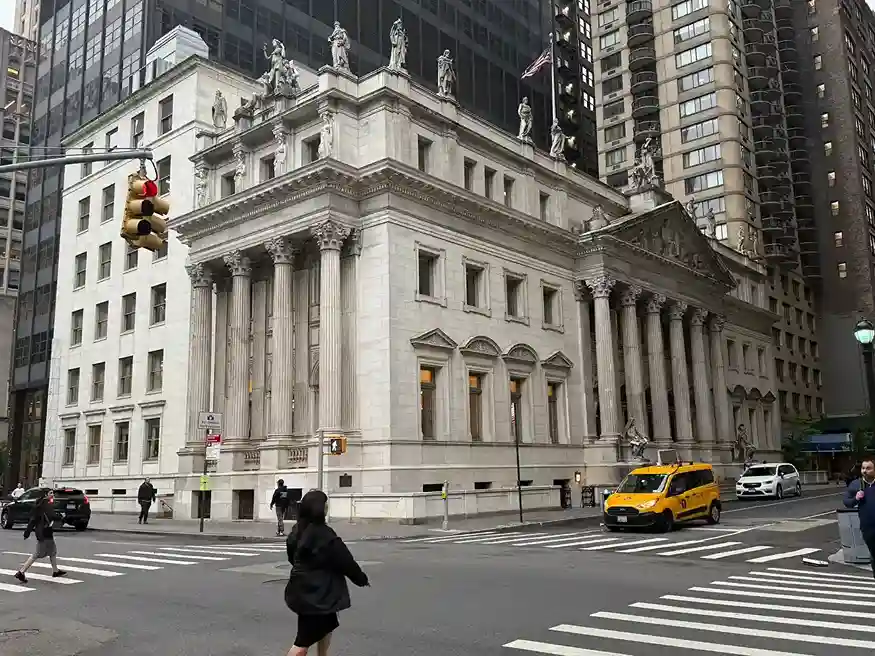
If you’re walking through the Flatiron neighborhood and look at the corner of Madison Avenue and East 25th Street, you’ll see a building that looks like it came straight out of a historical movie: the Appellate Division Courthouse in Flatiron.
With its detailed sculptures, white marble facade, and huge columns, it’s not just a courthouse, it’s practically an outdoor work of art. Even those who know nothing about law end up stopping to admire it.
There is so much history in its architecture.
✨ Highlights: Key Facts on Flatiron Courthouse
🏛️ Beaux-Arts Masterpiece by Lord: 1900 Renaissance Revival at 27 Madison Ave, white marble facade on Madison Square Park edge.
⚖️ First Department Appeals Hub: Reviews Manhattan/Bronx cases from trial/family courts, busiest in NY with public/live sessions.
🗽 Sculpted Wisdom Icons: Statues by French/Bitter include Justice, Moses; interior Siena marble, stained glass dome.
📜 NYC Landmark Since 1966: Exterior/interior protected, National Register 1982; Holocaust memorial adds reflection.
This building is part of the New York State Supreme Court, more specifically the First Department Appellate Division, where appeals from Manhattan and the Bronx are heard.
But the most interesting thing is that, in addition to all the formality of justice, it carries a lot of history and beauty: it is one of the most striking and photogenic buildings in New York.
📍 Key Facts About the Appellate Division Courthouse in Flatiron
| Aspect | Details |
|---|---|
| Location | 27 Madison Avenue, at the corner of Madison Avenue and East 25th Street |
| Court Location | Eastern edge of Madison Square Park |
| Opened | January 2, 1900 |
| Architect | James Brown Lord |
| Style | Renaissance Revival and Beaux-Arts architecture |
| Landmark Status | NYC Landmark (exterior: 1966, interior: 1981); National Register of Historic Places (1982) |
| Court Type | Intermediate appellate court (First Department) |
| Jurisdiction | Appeals from Family Court, trial courts, and administrative agencies |
| Interior Highlights | Siena marble walls, Corinthian pilasters, stained glass dome |
| Exterior Features | Decorative features, statues, columned porches |
| Caseload | One of the busiest appellate courts in the country |
| Access | Public access, live stream oral arguments, public records available |
🏛️ History of the Appellate Division Courthouse in Flatiron
The Appellate Division of the New York State Supreme Court, First Department, was established there in 1894, when the city could no longer handle the number of appeals coming from lower courts, such as the Family Court and the trial courts of Manhattan and the Bronx.
At first, the staff worked in rented offices on Fifth Avenue, but they soon realized they needed a permanent space, something commensurate with the court’s importance.
So, in 1896, the city purchased a plot of land at 27 Madison Avenue, right at the eastern tip of Madison Square Park. The location was carefully chosen: visible, elegant, and surrounded by other historic buildings.
The project was entrusted to architect James Brown Lord, who believed in a concept typical of the Beaux-Arts style, namely that public buildings should be works of art, not just functional structures.
And that is exactly what he delivered. Even without clear records of who the structural engineer was, the result was a grand building, built under budget at $640,000, and officially opened on January 2, 1900.
Appellate Division Courthouse in Flatiron
🏗️ Architectural Details and the Artistic Side of the Courthouse
This building is a true showcase of Renaissance and Beaux-Arts architecture, the kind where you look at it and immediately sense that every detail has a story to tell.
The white marble façade, built primarily from Tuckahoe marble quarried in New York, with later restorations using matching Alabama marble. It shines differently depending on the daylight and adds that touch of elegance that only classic New York buildings have.
But what really catches the eye are the sculptures. Imagine walking by and seeing Moses, Justinian, Zoroaster, and Confucius side by side, watching over the city from above, all symbols of wisdom and law.
And to top it off, there are also the personifications of Justice and Wisdom, as if the entire building were reminding everyone of its purpose.
These works were sculpted by legendary artists such as Daniel Chester French (the same artist who created the Lincoln Memorial in Washington) and Karl Bitter.
And here’s an interesting fact: the sculptural program was one of the most ambitious and expensive ever commissioned for a courthouse at the time.
To this day, the courthouse is considered one of the most artistically rich public spaces in the United States.
🖼️ Interior Art and Design
Entering this courtroom is like stepping straight into the late 19th century, with every detail seemingly designed to impress.
The Siena marble walls, Corinthian pilasters, and gilded coffered ceiling create a scene that blends art and solemnity in perfect measure. And right in the center, a monumental glass chandelier steals the show with its soft glow.
The main hall is grand in scale, crowned by a stained-glass dome that floods the space with natural light.
The walls are adorned with murals by Edwin Blashfield and Henry Siddons Mowbray, two renowned names in American art, who transformed the space into a veritable gallery.
The original furniture, made by the legendary Herter Brothers, is still in use, a rare and elegant detail. And above the judges’ bench, an inscription in Latin recalls the essence of justice:
“Civil law should not be influenced by good character, broken by power, or degraded by money.”
It is impossible not to feel that the place combines everything that New York does best: art, history, and purpose in perfect harmony.
Appellate Division Courthouse in Flatiron
⚖️ The Role and Modern Procedures of the Court
Today, the Flatiron Appellate Division Court remains one of New York’s busiest courts. It is here that many cases get a “second chance,” from criminal appeals to complex civil matters and administrative disputes coming from lower courts or the Family Court.
The process typically begins with a notice of appeal, followed by formal petitions and, in some cases, oral hearings before a panel of judges.
Everything takes place publicly and transparently, in accordance with local state rules. Interestingly, although New York has its own set of rules, some procedures resemble practices adopted in other states, such as the Illinois Supreme Court.
Among the main differences from the federal system are the way judges are chosen, appointed by the state rather than the federal government, and the type of cases tried, which fall under state jurisdiction.
The court has also adapted to modern times: today it is possible to watch sessions live, consult public records, and even submit petitions digitally with hyperlinks. These technological updates have made work more agile and access to justice easier for everyone.
🗞️ 2025 Updates at the Courthouse
The First Department of the Appellate Division continues to evolve, and 2025 has been a busy year:
- July 2025: Governor Kathy Hochul appointed six new judges, strengthening the Appellate Division panel and bringing new perspectives to the court.
- March 2025: Presiding Judge Dianne T. Renwick announced that oral hearings would be held in the Bronx on April 8, an initiative to bring the court closer to local communities.
- October 2025: Important decisions were published related to family services and housing policy, issues that directly impact the lives of New Yorkers.
- In progress: The New York County Bar Association launched a pilot program to provide free legal assistance in civil cases, including Article 78 cases, which deal with reviews of administrative decisions.
🧭 Final Thoughts
The Flatiron Appellate Division Court is much more than a legal building; it is a living symbol of history, art, and justice in New York City. It is a place where marble meets democracy, and where every architectural detail tells a little piece of the city’s past.
More than just a place for trials, it is a cultural landmark that shows how tradition and civic duty can coexist elegantly in the 21st century.
And if you enjoy discovering places full of history and personality, it’s worth exploring other hidden gems in the neighborhood.
Visit MeetFlatiron.com and sign up to receive updates, historical tidbits, and guides to legal landmarks that make the Flatiron even more fascinating.
💭FAQ – Frequently Asked Questions
Where Is the Court Located?
At 27 Madison Avenue, right on the corner of East 25th Street, on the east side of Madison Square Park. You can’t miss the white marble and sculptures on the facade.
Is It Open to the Public?
Yes! Oral hearings are open to the public, records can be consulted at the registry, and many sessions are broadcast live during the week.
What Are the Architectural Highlights?
The interior is a spectacle in itself: Siena marble, Corinthian pilasters, a coffered ceiling with gold trim, a stained glass dome, and original furniture by the Herter Brothers, all carefully preserved.
How Does It Differ From Federal Courts?
Everything here is at the state level: judges are appointed by the state of New York, and the court hears cases based on state law, not federal law.
Is There a Holocaust Memorial?
Yes. Since 1990, the court’s Holocaust Memorial has honored the victims of injustice with a symbolic column and a marble map of Auschwitz, a space for quiet reflection amid the legal routine.
Explore All The Flatiron District has to Offer
🏙️ Explore iconic spots and hidden gems in the Flatiron District NYC.