

You know that golden pyramid that rises above the trees in Madison Square Park? That’s the New York Life Building. Whenever I walk by, it catches my eye because it shines in a unique way.
This building isn’t just another skyscraper in New York. It has an incredible neo-Gothic style that still impresses those who live in the city today. It’s one of the standout landmarks in the area’s rich architectural history.
✨ Highlights: Key Facts on NY Life Building
🏛️ Cass Gilbert’s Neo-Gothic Masterpiece: 1928 headquarters at 51 Madison Ave, inspired by English cathedrals.
🪙 22-Karat Gold Pyramid Roof: Octagonal crown shines with real gold leaf, meticulously restored for Flatiron views.
🎪 From Circus to Corporate Icon: Replaced Stanford White’s Madison Square Garden, once home to Barnum’s elephants.
📸 Sunset Glow from Park: Frame the pyramid northeast in Madison Square Park for golden hour brilliance.
New York Life Building: Overview
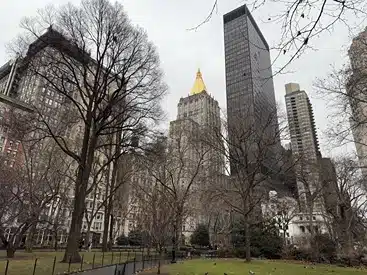
📍 The building is located at 51 Madison Avenue, right between 26th and 27th Streets.
📮 The zip code is 10010, in the United States.
🏛️ It was built there in 1928.
✨ Today, it remains the headquarters of the New York Life Insurance Company.
The Architect Behind the Magic
The person who brought this marvel to life was renowned architect Cass Gilbert. You may have heard of him for other notable works, such as the Woolworth Building in New York and the United States Supreme Court building.
Gilbert was one of the first to advocate for skyscrapers, but he wasn’t content with just building tall buildings. He wanted to create monuments that would last, and he succeeded
New York Life Building: That Famous Golden Crown
You know that golden pyramid roof that everyone loves to photograph? Well, it’s not paint, it’s real gold, 22 karats. They are very thin sheets, weighing only one gram each, carefully applied to this octagonal pyramid that shines in a unique way in Manhattan.
When renovations take place, teams carefully replace the clay and ceramic tiles with new ones. All of this is done with temporary protection systems, just to ensure that the building’s history remains intact while the work is being done.
A Building with Serious Credentials
This building is not only impressive in appearance, it also has a number of prestigious titles:
- It is a historic landmark in New York City.
- It is listed on the National Register of Historic Places.
- It has been considered for National Historic Landmark status.
In addition, the New York Landmarks Conservancy often cites the building as one of the city’s great architectural treasures, with enormous historical significance.
Where to Take the Perfect Photo
Want to guarantee an Instagram-worthy photo? Then do this: go to the northeast corner of Madison Square Park and look towards 27th Street. From this spot, the golden pyramid is perfectly framed between the trees.
And there’s more: if you can, go there about an hour before sunset. That’s when the 22-karat gold shines even brighter, and the photo turns out simply amazing.
The Days of Madison Square Garden
Before becoming the headquarters of New York Life, this address was home to the second Madison Square Garden, which opened in 1890. At the time, it was Manhattan’s most famous venue for live events: concerts, theatrical performances, boxing—everything happened there.
The project was designed by architect Stanford White, who created a bold building for its time, with a rooftop garden and an observation tower that marked the city skyline.
Fun fact: this Madison Square Garden was demolished in 1925 to make way for the current building. And the story also has a controversial side — Stanford White was murdered there, in a crime of passion that became known as the “Crime of the Century.”
P.T. Barnum’s Playground
P.T. Barnum, owner of a traveling circus and member of Ringling Bros. (Barnum & Bailey), turned this place into his permanent venue for shows.
The program was jaw-dropping:
- Circus performances with elephants and acrobats
- Political conventions that even nominated presidents
- Real chariot races (yes, that happened)
- Political events for New York’s elite
- And popular entertainment of all kinds
Some called the space the famous racetrack. Others preferred to say it was simply New York’s entertainment center.
From the Circus to the Corporate World
After the inauguration of Grand Central Terminal in 1913, Manhattan’s commercial heart began to shift northward. Companies and offices left the Madison Square area and migrated to areas closer to the new station, which became a major business hub.
This movement ended up transforming former leisure and entertainment venues, such as Barnum’s circus and Madison Square Garden, into sought-after sites for corporate buildings, such as the New York Life Building.
The Great Migration
Companies began to leave their offices in southern Manhattan, around West Street and Monroe Street. The reason was simple: they were looking for locations that offered more future potential and were close to new transportation hubs.
And that’s when this area gained momentum. Workers reached the district easily thanks to nearby elevated trains, streetcar lines, and the newly expanding subway network.
Building the Cathedral of Insurance
In 1928, New York Life inaugurated its new headquarters.
The team responsible for the project created more than just offices, they built a welcoming workspace that conveyed stability. The building’s design featured intricate Gothic details inspired by Salisbury Cathedral, that famous English landmark.
For entrepreneurs and small business customers, the architecture itself sent a message: Your long-term protection is safe with us.
Architecture That Means Business
This new building was not only beautiful, it also represented a smart investment strategy on several levels. Every detail of the construction, from the choice of land to the imposing design, conveyed solidity and confidence, showing that New York Life was thinking about the future of the business and its customers.
The Design Philosophy
Cass Gilbert created one of the finest examples of Gothic architecture in the United States. Every detail, from the intricate ornamentation at street level to the golden pyramidal roof, conveyed a sense of permanence and solidity.
The building occupies an entire block, offering plenty of space at a lower cost than comparable buildings in Midtown, showing that beauty and strategy could go hand in hand.
Why It Works for Insurance
Insurance means important things:
- Stable income streams
- Growth in the cash value of the policy
- Long-term coverage protection
- Long-lasting investment strategy
And the building’s architecture reflects exactly these values. Every detail conveys stability, trust, and durability, which is why they call it the “Cathedral of Insurance.
The Modern Era
Today, the headquarters of the New York Life Insurance Company continues to operate at full speed.
The building not only houses the daily operations of one of the largest insurance companies in the United States, but also maintains its role as a symbol of financial stability and architectural excellence in Manhattan.
Despite being nearly a century old, the “Cathedral of Insurance” continues to impress residents and visitors alike, combining history, beauty, and functionality in a single iconic space.
Connecting with the community
New York Life’s commitment to the community extends far beyond the building:
- Local sponsorships throughout Madison Square Park
- Volunteer programs along Park Avenue South
- Neighborhood events that bring different communities together
These initiatives show that, in addition to being an architectural icon, the company is also dedicated to strengthening ties with the people and the city around it, keeping alive the tradition of positively impacting the community.
Keeping It Golden
The modern restoration of the building is highly technological. Teams use BIM modeling to coordinate every detail of the repairs. Among the tasks are:
- Replacement of ceramic tiles
- Installing new clay tiles
- Providing temporary protection while work is underway
- Preserving historical materials
All of this ensures that the golden pyramid roof continues to shine, keeping the building’s beauty and history intact for future generations.
New York Life Building: Visit Like a Local
How to get there:
- Subway: R/W lines to 23rd Street or 6 line to 28th Street
- Best views: from Madison Square Park, especially from the northeast corner
- Best lighting: during golden hour, about an hour before sunset
By following these tips, you can see the golden pyramid in all its splendor and enjoy the neighborhood atmosphere like a true New Yorker.
Make it a special day
- Start by visiting the Flatiron Building, one of New York’s most iconic buildings.
- Then stroll through Madison Square Park, with its more than 2.5 acres of greenery and charming corners.
- Be sure to admire the New York Life Building as you walk through the area.
- At lunchtime, choose between the classic Shake Shack or the delicious Eataly.
Then explore the shops on Park Avenue South and end the day with cocktails at NoMad, enjoying the lively vibe of the neighborhood.
The Details That Matter: Historical Significance
This building is not just another old building. The New York Times archives are full of stories about its transformation, from the days of the Second Madison Square Garden to becoming a corporate landmark in Manhattan.
It has weathered everything from fears of foreclosure auctions in the area to multiple economic recessions, maintaining its imposing presence and relevance over the years.
This isn’t just another old building. The New York Times archives are full of stories about its transformation from the “Second Garden” era to corporate landmark.
It survived everything from foreclosure auction scares in the neighborhood to multiple economic downturns.
Why Preservation Matters
The building represents much more than just an address:
- One of the finest examples of Gothic architecture in the United States
- A masterpiece of neo-Gothic architecture that inspired many imitators
- Stone carving techniques that are now almost extinct
- A true architectural marvel of the Jazz Age
Preserving this building means keeping alive the history, art, and engineering of an era that profoundly marked Manhattan.
Fun Facts You Can Share at Parties
- 🎪 Circus history: today the offices are full of accountants, but Elephants from the Barnum & Bailey circus DID perform inside Madison Square Garden II, which stood on the exact site where the New York Life Building stands today.
- 🏛️ Gothic inspiration: the building’s tower was inspired by English cathedrals, with details that still impress today.
- 🚂 Transportation fun fact: the building’s location was also chosen because it was close to several train lines, making it easy to get to.
- 💰 Smart investment: the building offered more space per square foot than many buildings on Fifth Avenue.
- 🏗️ Still growing: it continues to be a welcoming workplace, always updated with modern amenities.
The Connection With Insurance
For those interested in the commercial side:
The building reflects the fundamental principles of insurance. Just as the cash value of a policy grows over time, the building has also appreciated enormously over the years. Its solid presence conveys confidence to small business owners, showing that their long-term protection is guaranteed.
In addition, stable income streams from insurance premiums have helped finance this veritable monument to financial security, making the building a symbol of solidity and smart planning.
Why This Building is Still Important
In a city that always seems to be chasing the new, the New York Life Insurance Building proves that certain works deserve to remain.
From the time it housed P.T. Barnum’s circus shows and political conventions to becoming the heart of modern insurance operations, the building has accompanied and reflected the transformation of New York.
More than an architectural landmark, it symbolizes continuity: it went from being a popular entertainment center to a corporate headquarters, but never lost its grandeur or its ability to tell the story of the city.
New York Life Building: Conclusion
Next time you pass by Madison Square Park, look up.
That golden pyramid roof, covered with gold leaf, is not only beautiful, it is history transformed into architecture. The so-called Insurance Cathedral proves that long-term choices can yield extraordinary results.
Whether for its architecture, history, or simply the perfect Instagram shot, the New York Life Building does not disappoint. It reminds us that the best of New York is not always the newest: sometimes it is the building that has stood, quietly grand, for nearly a century.
💭 FAQ – Frequently Asked Questions
What is the “Golden Pyramid” Above Madison Square Park?
The “Golden Pyramid” refers to the gilded, pyramid-shaped rooftop feature that crowns one of the historic buildings overlooking Madison Square Park, known for its eye-catching shimmer.
Why Does the Golden Pyramid Stand Out in the Neighborhood?
Its metallic finish and geometric shape create a striking contrast with the surrounding skyline, making it a recognizable architectural detail for anyone visiting the park.
Can Visitors Access the Building with the Golden Pyramid?
No, the rooftop structure is not open to the public. It can only be admired from street level or from various viewpoints around Madison Square Park.
Is the Golden Pyramid Illuminated at Night?
Yes, the structure often reflects ambient city lighting at night, and depending on the season, it may appear to glow with a warm golden hue.
What Building Does the Golden Pyramid Belong to?
New York Life Building: The Golden Pyramid sits atop a historic commercial building on the park’s perimeter; while the roof feature is famous, the building itself primarily houses offices and private tenants.
Explore All The Flatiron District has to Offer
🏙️ Explore iconic spots and hidden gems in the Flatiron District NYC.