
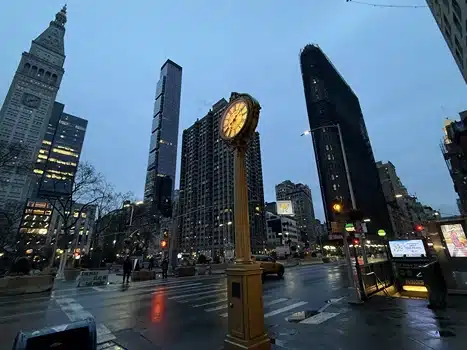

Augustus Saint-Gaudens (1848–1907) was the foremost American sculptor of the Gilded Age, whose work in the Flatiron District changed how Americans thought about public monuments. Born in Dublin and raised in New York City, he maintained studios in Manhattan's artistic corridor between 14th and 36th Streets throughout the 1870s and 1880s.
His 1881 Admiral Farragut Monument in Madison Square Park at 26th Street and Fifth Avenue was the first American sculpture to fully integrate statue and architectural setting — a collaboration with Stanford White that launched both men into the creative elite. The bronze figure still stands at the park's north end, the oldest sculpture in one of New York's most visited public spaces.
| Full name | Augustus Saint-Gaudens |
| Born / Died | March 1, 1848 / August 3, 1907 |
| Profession | Sculptor; fine artist; coin designer; co-founder, Society of American Artists |
| Active in Flatiron | c. 1870–1907 |
| Known for | Admiral Farragut Monument in Madison Square Park, Shaw Memorial in Boston, $20 Double Eagle gold coin design |
| Key Flatiron location | Admiral Farragut Monument, Madison Square Park (north end near 26th Street & Fifth Avenue), unveiled 1881 — still standing, NYC Landmark |
| Notable legacy | Saint-Gaudens transformed American public sculpture from stiff memorial statuary into dynamic, emotionally resonant art, and his Madison Square Park monument launched the collaboration that defined Gilded Age New York. |
Who Was Augustus?
Augustus Saint-Gaudens arrived in New York as an infant in 1848, his Irish-born father and French mother settling in the city that would shape his artistic career. By age 13, he was apprenticed to a cameo cutter named Louis Avet at 537 Broadway, spending six years carving tiny portraits into shell and stone before ever touching formal sculpture.
From Cameos to Monuments
That early training gave him an obsessive attention to surface detail that would later distinguish his public monuments. After studying in Paris and Rome, Saint-Gaudens returned to New York in the early 1870s and established himself in the studio buildings that dotted the area between Union Square and Herald Square — the creative heart of what would become the Flatiron District.
He was notoriously meticulous. The Shaw Memorial in Boston took him 14 years to complete because he insisted on creating individual, dignified portraits of each of the 23 Black soldiers depicted — an artistic and political choice that was radical for its time.
The Artist’s Personality
Colleagues described him as intensely focused, prone to working through the night, and dismissive of anything he considered mediocre. He surrounded himself with other perfectionists: Stanford White, John La Farge, and the architects of McKim, Mead & White. Together, they created what historians now call the American Renaissance.
Augustus Saint-Gaudens's Connection to the Flatiron District
The Flatiron District was the creative epicenter of Gilded Age New York, and Augustus Saint-Gaudens worked at its heart during the most productive decades of his career.
Studios in Manhattan’s Artistic Corridor
Throughout the 1870s and 1880s, Saint-Gaudens maintained studios in the area stretching from 14th Street to 36th Street. His workspace at the Germain Building at 148 West 36th Street [VERIFY] placed him among the sculptors, painters, and architects who made this neighborhood America’s creative capital. His family residence at 3 West 22nd Street [VERIFY] kept him within walking distance of the projects that would define his legacy.
The Farragut Monument: Madison Square Park
In 1881, Saint-Gaudens unveiled the Admiral David Farragut Monument at the northwest corner of Madison Square Park at 26th Street and Fifth Avenue. More than 10,000 people attended the Memorial Day dedication. The sculpture was revolutionary: rather than placing a heroic figure on a generic pedestal, Saint-Gaudens collaborated with architect Stanford White to create an integrated artistic statement.
White designed the bluestone base with allegorical figures representing Loyalty and Courage, while Saint-Gaudens’ bronze Farragut seems to lean into an invisible wind, feet firmly planted on a ship’s deck. It was the first time an American monument had been conceived as total design — sculpture, architecture, and setting working as one. Today, it remains one of the essential monuments in Madison Square Park.
The statue now stands at the park’s north end (it was relocated within the park in 1935) and remains Madison Square Park’s oldest monument.
The Players Club Connection
Just blocks away at 16 Gramercy Park South, Saint-Gaudens created the bronze bas-relief portrait of Edwin Booth that hangs above the fireplace at The Players Club. Booth founded the club in 1888, and Saint-Gaudens’ sensitive portrait of the actor — America’s greatest Hamlet — remains one of the building’s treasures.
The Masonic Temple Commission
In 1876, Saint-Gaudens created his “Silence” sculpture for the Masonic Temple that once stood at 23rd Street and Sixth Avenue [VERIFY]. Though the building was demolished in 1939, this commission was among his earliest architectural sculpture projects in New York — part of the remarkable architectural heritage that defined the neighborhood.
Legacy and Impact
Augustus Saint-Gaudens didn’t just create monuments — he invented a new way of thinking about public art in America. Before the Farragut Monument, American sculpture was largely imported or imitative. After it, commissioners understood that a statue could be a unified artistic vision, not just a bronze man on a marble box.
His collaboration with Stanford White produced at least 15 major projects and established the model for architect-sculptor partnerships that would define public spaces for the next generation. When Theodore Roosevelt wanted to beautify American coinage in 1907, he went directly to Saint-Gaudens. The resulting $20 Double Eagle is still called “the most beautiful American coin ever minted” by numismatists.
What Visitors Can Still Experience
Today, visitors to Madison Square Park can stand before the Farragut Monument exactly where New Yorkers gathered in 1881. A self-guided walking tour of the Flatiron District includes this and other Gilded Age landmarks. The Metropolitan Museum of Art holds a major collection of his bronzes and plasters. And his former home and studios in Cornish, New Hampshire — now the Saint-Gaudens National Historical Park — displays over 100 of his works in the landscape he loved.
His influence runs through every American war memorial, every collaboration between architects and sculptors, every coin designed with artistic intention. He proved that public art could move people, not just commemorate them.
Augustus Saint-Gaudens taught America that a statue could make you feel something. The Farragut Monument in Madison Square Park wasn't just bronze and stone — it was drama, weather, and defiance frozen in metal. Every public sculpture that moves you, rather than bores you, owes him a debt.
Key Facts Worth Knowing
- 1881: Over 10,000 people attended the Memorial Day unveiling of the Farragut Monument in Madison Square Park — the largest crowd for a sculpture dedication in American history to that point.
- 14 years: The time Saint-Gaudens spent perfecting the Shaw Memorial (1884–1897), repeatedly reworking the faces of 23 individual Black soldiers until each was a distinct portrait.
- 1861: At age 13, Saint-Gaudens began a six-year apprenticeship carving cameos at 537 Broadway — his entire formal training before studying sculpture in Paris.
- 11 strikings: The number of impressions required to achieve the ultra-high relief Saint-Gaudens demanded for his $20 Double Eagle coin, making the original design impractical for mass production.
- 15+ projects: The number of major commissions on which Saint-Gaudens and Stanford White collaborated between 1878 and 1906, including the Farragut Monument and Adams Memorial.
FIND THEIR LEGACY TODAY
- Admiral Farragut Monument, Madison Square Park (north end near 26th Street & Fifth Avenue) — Look for the bronze naval officer leaning into an invisible wind, standing on Stanford White's allegorical base. The oldest sculpture in the park.
- The Players Club, 16 Gramercy Park South — The landmarked building contains Saint-Gaudens' bronze bas-relief portrait of Edwin Booth above the main fireplace. The club is private but occasionally opens for events.
- 71 West 23rd Street (former Masonic Temple site) — Saint-Gaudens' "Silence" sculpture once stood here [VERIFY]. The original temple was demolished in 1939; a commercial building now occupies the site.
- 148 West 36th Street (Germain Building) — One of Saint-Gaudens' studio locations in the 1870s–1880s [VERIFY]. The building has been modified but still stands in what is now the Garment District.
Explore More of Flatiron's History
→ Madison Square Park Monuments: The Stories New Yorkers Walk Past Every Day — The complete guide to Madison Square Park's sculptures, including Saint-Gaudens' Farragut Monument.
→ Madison Square Park NYC: What to See, Eat & Do (2025) — A visitor's guide to the park where Saint-Gaudens' breakthrough monument still stands.
→ Flatiron District History: NYC's Landmark Evolution — How the neighborhood became the creative capital of Gilded Age New York.
→ Flatiron District Architecture Guide | Iconic NYC Landmarks — The buildings that surrounded Saint-Gaudens during his most productive years.
→ Flatiron District Walking Tour – Historic NYC Landmarks — A self-guided tour that includes the Farragut Monument and other Gilded Age sites.
In Plain English
Augustus Saint-Gaudens (1848–1907) was the most celebrated American sculptor of the Gilded Age. He maintained studios in Manhattan's Flatiron District during the 1870s and 1880s and created the Admiral Farragut Monument in Madison Square Park in 1881 — the first American sculpture to fully integrate statue and architectural setting. He also designed the $20 Double Eagle gold coin, often called the most beautiful American coin ever minted.
Frequently Asked Questions About Augustus Saint-Gaudens
Q: What is Augustus Saint-Gaudens famous for?
A: Augustus Saint-Gaudens is famous for transforming American public sculpture through works like the Admiral Farragut Monument in Madison Square Park (1881), the Shaw Memorial in Boston, and the Standing Lincoln in Chicago. He also designed the $20 Double Eagle gold coin, commissioned by Theodore Roosevelt in 1907 and still considered the most beautiful American coin ever minted.
Q: Where can I see Augustus Saint-Gaudens sculptures in New York?
A: The Admiral Farragut Monument stands at the north end of Madison Square Park near 26th Street and Fifth Avenue — it's his most significant New York work. The Metropolitan Museum of Art also holds a major collection of his bronzes and plasters. The Players Club at 16 Gramercy Park South contains his bas-relief portrait of Edwin Booth, though the club is private.
Q: What coins did Augustus Saint-Gaudens design?
A: Saint-Gaudens designed the $20 Double Eagle gold coin and the $10 Eagle gold coin in 1907, both commissioned by President Theodore Roosevelt. The Double Eagle required 11 strikings to achieve the ultra-high relief Saint-Gaudens demanded, making the original design impractical for mass production. Modified versions remained in circulation until 1933.
Q: Where is Augustus Saint-Gaudens buried?
A: Augustus Saint-Gaudens is buried at his home and studio in Cornish, New Hampshire, which is now the Saint-Gaudens National Historical Park. The site, operated by the National Park Service, displays over 100 of his works and includes his studios, gardens, and the landscape that inspired his later career.
Q: Who was Stanford White and how did he work with Augustus Saint-Gaudens?
A: Stanford White was the celebrated architect of McKim, Mead & White and Saint-Gaudens' closest artistic collaborator. They worked together on at least 15 major projects, including the Farragut Monument in Madison Square Park, where White designed the allegorical base while Saint-Gaudens created the bronze statue. Their partnership helped define the American Renaissance style.