

Let me tell you a secret: a Flatiron District map can be your best friend during any trip, regardless of how many times you have been here before.
Although streets are generally well signed, New York City can be confusing without proper guidance.
And even GPS can fail if we use it without the proper understanding of Flatiron.
Defining the Flatiron District isn’t an easy feat. A quick answer is that Flatiron District boundaries stretch from 20th to 27th Street (north to south) and from Sixth Avenue (aka Avenue of the Americas) to Lexington Avenue (east to west), centered around Madison Square Park and the Flatiron Building.
In all honesty? The boundaries can shift a little depending on who you ask and how they choose to answer.
If Flatiron is your base, this guide to hotels in the Flatiron District shows where to stay for the best location.
Before diving into the map itself, it helps to understand the layout and character of the Flatiron District NYC — one of Manhattan’s most iconic and walkable neighborhoods.
✨ Highlights: Core Flatiron District Map Boundaries
🗺️ Core Heart (Undisputed Zone): 22nd–25th Streets, Fifth Ave to Park Ave South, centering Madison Square Park.
⬆️ Northern Stretch (Debated North): Up to 27th/28th St, brushing New York Life’s pyramid into NoMad fade.
⬇️ Southern Reach (Historical South): Down to 20th St, including Teddy Roosevelt’s birthplace near Union Square.
➡️ Eastern Limit (Gramercy Blend): Lexington Ave, where offices quiet into residential brownstones.
⬅️ Western Edge (Chelsea Shift): Sixth Ave, galleries signaling transition from Flatiron bustle.
Flatiron District Free Map
Like I said before, defining the limits in a Flatiron District map can be tricky, depending on where you look for it. You can always look up the Flatiron District on your preferred navigation phone app for the most agreed-upon Flatiron map.
For something that can turn your exploring into guided adventures, the Flatiron NoMad partnership has a great option that you can filter depending on which category of business you need.
Where to Find a Free Flatiron District Map
If more elaborate maps are your thing, head over to the website for the Flatiron NoMad partnership and click the map icon in the top left corner. From there, you can filter by hotel & transportation, food, retail, and more.
Flatiron District Map: Free Walking Tour Map
There are two ways you can follow a walking tour Flatiron District Map. The Flatiron NoMad partnership offers a free guided walking tour on the first Sunday of every month, regardless of the weather.
And you can create your own map by pinning some key locations on a personalized Google Map.
Here are some key spots I recommend you add to your Flatiron District map:
- Flatiron Building: the neighborhood icon
- Madison Square Park: our communal green space, home ot the first Shake Shack
- Museum of Mathematics (MoMath): interactive exhibits for all ages
- Harry Potter New York: the brand’s only flagship location
- Theodore Roosevelt Birthplace: an underrated gem with free guided visitation
The Truth About Flatiron’s Fuzzy Edges
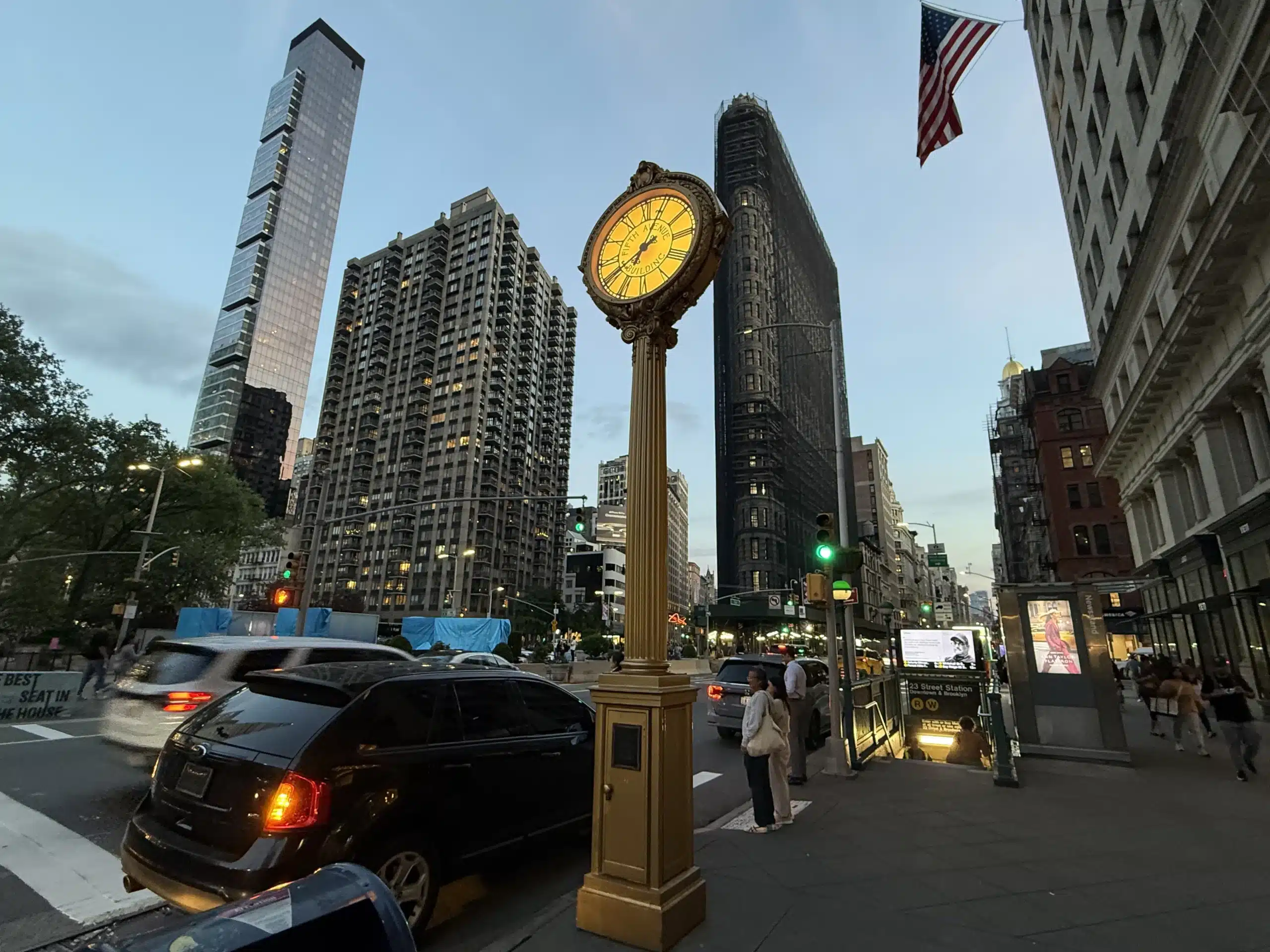
Let me be real with you about defining a Flatiron District map; boundaries are mostly suggestions rather than science in the borough of Manhattan of New York City.
Walk around this neighborhood for long enough and you’ll end up hearing endless debates about whether a building on 20th Street is “really” in Flatiron or it’s actually part of Union Square. Truth is, both sides will have a point.
Here’s what actually happens: Real estate agents can stretch limits when selling New York City properties to make things more attractive.
Restaurants claim the ‘Flatiron District’ label to sound trendy. The city shrinks it for official purposes. And us locals? We just say “near Madison Square Park” and everyone knows what that means.
Here is the core thing everyone agrees on: If you’re standing in Madison Square Park and look at the Flatiron Building, you’re in the Flatiron District. No debate there. But start walking five blocks in any direction, and things will get interesting.
The Maximum Edges of a Flatiron District Map (What Locals Really Consider Flatiron)
After years of conversations with friends, just as many arguments, and paying attention to where people actually go when we say “let’s meet in Flatiron,” here are the boundaries I have noticed:
North: 27th Street (Sometimes 28th)
Once you pass by the New York Life Building’s golden pyramid at the corner of 26th St and Madison Avenue, you’re technically entering NoMad territory. But plenty of businesses on 27th Street proudly say “Flatiron” on their awnings. I have even seen brave souls claim 28th Street is still in a Flatiron District map when the rental market is tight.
South: 20th Street (The Historical Argument)
The birthplace of Theodore Roosevelt sits at 28 East 20th Street. It’s a very important national historic site! If Teddy Roosevelt’s biography says he lived in Flatiron, who are we to argue? Plus, tons of people living between 20th and 22nd consider themselves Flatiron locals.
West: Sixth Avenue (Avenue of the Americas)
Cross Sixth Avenue heading west, and you’re in Chelsea. The vibe shifts immediately—galleries replace office buildings, the sidewalks get quieter. Though some optimistic real estate activity stretches it to Seventh Avenue. (They’re wrong, but I admire the hustle.)
East: Lexington Avenue (The Gramercy Fade)
Park Avenue South is the most commonly accepted eastern edge, but walk to Lexington Avenue and you’ll still find businesses claiming Flatiron. Beyond that, you are solidly in Gramercy Park territory.
You’ll know because suddenly everything becomes a residential area type of quiet. Irving Place runs parallel here, adding to the neighborhood charm.
Your Street-by-Street Reality Check
Now that we know the limits of a regular Flatiron District Map, let’s get to know the neighborhood itself! We are walking through what each street feels like daily:
27th Street
The vibe: Transitioning into the neighborhood. Korean restaurants pop up, there’s some flower district spillover, plus many confused tourists walking along the sidewalk.
Flatiron claim: 50/50. Depends on whether they’re selling you something.
What’s here: Site of the former Jazz Standard (closed 2020), decent coffee shops, and that feeling of being between neighborhoods.
26th Street
The vibe: Peak Flatiron atmosphere. This is the district’s postcard location!
Flatiron claim: 100%. No doubt about it.
What’s here: New York Life Building, Madison Square Park views, that feeling of being exactly where you should be.
25th Street
The vibe: Professional side of Flatiron. More formal wear and structure.
Flatiron claim: Absolutely in the middle of the district.
What’s here: Appellate Court, traditional architecture, lawyers on lunch break, and some more upscale restaurants hiding on side streets.
24th Street
The vibe: Classic Flatiron District. Tourist central merges with local life.
Flatiron claim: The heart of it all; it is in every Flatiron District map.
What’s here: Met Life Tower (it was once the tallest building in the world), park entrances, and that one corner where everyone takes the same photo in front of the Flatiron Building.
23rd Street
The vibe: The Main Event. Chaos at the intersection of Fifth Avenue and Broadway.
Flatiron claim: This IS Flatiron.
What’s here: The Flatiron Building itself in its distinctive triangular shape, pedestrian plazas, and more people taking pics than anywhere else in the district.
22nd Street
The vibe: Quieting down but still buzzing.
Flatiron claim: Definitely in it.
What’s here: Great restaurants, residential buildings that can cost more than some small countries.
21st Street
The vibe: The southern edge of the neighborhood is getting fuzzy.
Flatiron claim: Usually yes, sometimes “Flatiron/Union Square’ depending on who you ask.
What’s here: Mix of everything you could need: offices, apartments, that famous deli everyone loves.
20th Street
The vibe: The true debatable zone.
Flatiron claim: Real estate says that it is in the Flatiron District map, purists say no, I say: why not?
What’s here: Teddy Roosevelt’s birthplace, cheaper rent (when compared to other streets), and the beginning of Union Square’s influence.
What’s Actually Inside the Boundaries in a Flatiron District Map
Now that we know how far the Flatiron District goes, let’s see what is actually inside the limits!
The Undisputed Landmarks
These belong to the district, no matter who you ask.
The Flatiron Building (Fuller Building)
Located at 175 Fifth Avenue and 23rd Street, it is the whole reason this neighborhood has this particular name, due to the angle of the land where Broadway cuts through and creates this iconic triangular shape. That triangular beauty on its impossibly thin lot still makes people stop and stare.
Madison Square Park
The actual center of everything in the neighborhood. It is 6.2 acres of greenery with the first-ever Shake Shack, a dog run that doubles as a social club, and art installations that change when you least expect them. This great place anchors the entire district.
Metropolitan Life Tower
700 feet of Venetian-inspired clock tower at the corner of Madison Avenue and 24th. It was once the tallest building in the world, but now it’s a fancy hotel (The EDITION). Still, those iconic clock faces run the neighborhood.
The Food Side of the Flatiron District
Want to grab an authentically New Yorker bite? Head over to any of these places.
Eleven Madison Park
Nearly at the corner of Madison and 24th, this is one of the world’s best restaurants. Truly the kind of place you save up for, then talk about for years to come.
Gramercy Tavern
42 East 20th, just next door to the Theodore Roosevelt Birthplace, Danny Meyer’s masterpiece is unmissable. A perfect spot to take your parents when they come to visit.
Original Shake Shack
Inside Madison Square Park. Yes, there will be lines. Yes, it will be worth it. This is where the elevated fast food empire started.
Union Square Cafe
101 E 19th Street. It used to be somewhere else, but it relocated here in 2016. Another Danny Meyer joint that defines New York dining.
Eisenberg’s Sandwich Shop
174 Fifth Avenue at 22nd. This place has remained unchanged since opening in 1929. The tuna melt could solve all of your problems on a bad day.
The Cultural Stuff
Because getting to know cultural places is never boring, these local spots are just waiting for you to arrive!
Museum of Mathematics (MoMath)
11 East 26th. The only math-focused museum in North America. Kids always love it, and adults mostly pretend they understand it.
Museum of Sex
233 Fifth at 27th. This place for grown-ups only is exactly what it sounds like. Your out-of-town friends will definitely have a blast.
Theodore Roosevelt Birthplace
28 East 20th. A perfectly reconstructed brownstone where Teddy spent his first 14 years of life. Free guided tours are available, and there is a great gift shop.
The Shopping Reality
When it comes to shopping, this neighborhood won’t be like SoHo or the uptown part of Fifth Avenue, but you will be able to get a lot done just the same.
Some of the he main spots here are:
- ABC Carpet & Home at 888 Broadway (19th Street) – the fancy home goods and furniture wonderland you go to shop or people watch
- Bookstores that survived Amazon, like Rizzoli
- Specialty food shops that make you feel sophisticated (Eataly)
- Fitness center options tucked into side streets (Equinox & Life Time)
- Some remnants of the old Ladies’ Mile Historic District department stores era
Where Flatiron Bleeds Into Other Neighborhoods
South: The Union Square Merge
Walk south from 20th Street, and you will gradually enter Union Square Park territory. You’ll be able to tell because:
- There’s suddenly a Whole Foods
- The subway station at 14th Street gets insanely busy most of the time
- Street performers appear with live music
- The Union Square Greenmarket on weekends takes over everything with fresh fruits and local vendors.
North: The NoMad Transition
Cross 27th Street heading north, and you’re in NoMad (North of Madison). The tells:
- Hotels get a distinct boutique-ier vibe
- Restaurants get trendier and more photogenic
- The crowd gets younger
- Rooftop bars multiply
- Madison Park marks the skyline near 25th Street and Madison Avenue
East: The Gramercy Fade
Go past Lexington Avenue toward Gramercy Park:
- Everything becomes quieter because it’s a residential area
- Brownstones replace those tall office buildings
- You need a resident key for the park (seriously)
West: The Chelsea Shift
Cross Sixth Avenue going west toward Midtown West:
- Art galleries appear in the streets
- The High Line beckons you for an elevated walk
- Greenwich Village and the West Village are a pleasant walk southwest
How to Navigate This Whole Area
The Local’s Walking Method
The best way to walk the district is to start at Madison Square Park and face any direction. Then, walk 10 minutes. Within this range, you get to see all, and after that, you’ve probably left Flatiron, but you’re definitely somewhere interesting.
The Landmark Navigation System
Here’s a rundown of where you are based on which iconic sight you can see, just in case you don’t feel like carrying a Flatiron District map.
- Can you see the Flatiron Building? You’re close enough to claim the Flatiron District.
- Can you see the Met Life Tower clock? Definitely in the district zone.
- Can you see the Empire State Building clearly? You’re probably way too far north.
- Is Union Square Park closer than Madison Square Park? You’ve gone too far south.
- Can you see Central Park? You’re way too far north. That’s Upper West Side and Upper East Side territory.
- Thinking about Wall Street or the Financial District? Those are downtown, a completely different world.
The Subway Reality
These are the best stations to reach the district at any time of the day.
- 23rd Street (N/R/W/6) – Multiple options, right in the heart
- 28th Street (6) – Northern edge of the neighborhood, but much less crowded
- Union Square (4/5/6/N/Q/R/W/L) – The mega-hub at 14th Street, a 10-minute walk from Flatiron.
Pro tip: The 23rd Street station on the 6 line has an unusually short platform. Board in the middle cars of the train, or you’ll be walking extra underground to reach the exit.
Why Every Map Shows Different Boundaries
There is a reason why different people claim different boundaries for their Flatiron District Map.
The Real Estate Version
Extends to 30th Street if it will help sell an individual property. “Flatiron-adjacent” turns into “Heart of Flatiron” real quick when there’s a big commission involved. The Residential Listing Service (RLS) data display often shows different boundaries for consumers’ consideration.
The City Planning Version
The most Conservative delimitation. Usually 22nd to 26th, Fifth to Park. They have to draw lines somewhere for zoning in the borough of Manhattan in New York City.
The Business Improvement District Version
These limits will be wherever they collect fees. Check the trash cans! If they have special logos, you’re in someone’s district. Courtesy of the Real Estate Board of New York, these boundaries matter for commercial purposes.
The Historical Version
Includes everything from the Ladies’ Mile Historic District era, with its old department stores. Could stretch down to 14th, over to Broadway. History doesn’t care about our modern boundaries. The old Silicon Alley tech boom added another layer to these fuzzy edges.
The Local’s Version
“Can I walk to Madison Square Park in flip-flops without regretting it?” If the answer is yes, you’re in Flatiron.
The Honest Walking Tour (30 Minutes)
Start at the corner of 20th Street and Broadway. Walk north to live this unforgettable experience.
20th to 21st: Notice how it’s quieter here? That’s the southern boundary debate in action. The birthplace of Theodore Roosevelt anchors this end of the district.
21st to 22nd: Things pick up. More suits, better coffee, office buildings getting denser.
22nd to 23rd Street: You’re approaching the main event at the intersection of Fifth Avenue and Broadway. Get your cameras out.
23rd Street: Stop to admire the Flatiron Building’s triangular shape. Take the photo everyone takes. This is the middle of the district.
23rd to 24th: Walk through Madison Square Park. Pet a random dog at the dog run. Judge the Original Shake Shack line. Enjoy this great place.
24th to 25th Street: Look east at the Met Life Tower (once the tallest building in town). Look north at New York Life. You’re in the sweetest spot of this vibrant neighborhood.
25th to 26th St: Still solid Flatiron District. Notice how the office buildings get a bit more residential? Some world-class restaurants are hiding here.
26th to 27th Streets: The northern edge. Feel the NoMad creeping in? That’s normal. This is the end of the district.
Turn around, walk back through this small area that packs so much history. Congratulations, you’ve covered the entire north-south debate!
Your Flatiron District Boundaries Reality Check
Here’s what spending any length of time in this neighborhood teaches you: The Flatiron District is a lot less about lines on a map and more about a feeling.
It is where Broadway’s diagonal creates those weird triangular corner lots. Where you can get a $3 coffee or a $30 cocktail on the same sidewalk. Where tourists photograph the Flatiron Building, dodging locals trying to get to work. Madison Square Park serves as everyone’s backyard.
The boundaries? They’re real when you’re giving directions, fuzzy when you’re selling real estate, and completely irrelevant when you’re just trying to find good tacos after a night out.
My advice: Walk from 20th to 27th Street, Sixth Avenue to Lexington. Somewhere in there, you’ll find your definition of Flatiron. The exact borders matter less than the fact that this small slice of Manhattan manages to be historical and modern, touristy and local, clearly defined and utterly debatable, all at the same time.
That’s not confusion. That’s New York.
If you want to truly get to know this amazing neighborhood, head over to MeetFlatiron.com for plenty of articles to help you navigate these streets.
💭FAQ – Frequently Asked Questions
Is There an Official Flatiron District Map?
No. And that’s the beauty of it. NYC neighborhoods are more about the general feeling of them than their borders. The city might have official Community Districts, but nobody actually uses those in conversation.
Why Do Different Websites Show Different Boundaries?
Because everyone has an agenda. Real estate sites want to maximize “hot neighborhood” listings. City planning needs neat lines. Tourism sites include whatever’s photogenic. Locals want to explain where they live without a geography lesson.
What’s the Absolute Maximum Anyone Claims?
I’ve seen listings claim “flatiron” as far north as 30th street and as far south as 17th street, both of which are a stretch of the truth. The honest maximum is 20th to 27th streets.
What’s the Absolute Minimum Everyone Agrees On?
22nd to 25th Streets, Fifth Avenue to Park Avenue South. Even the pickiest local can’t argue with that.
Is MoMath suitable for all ages?
Yes! MoMath is designed to be fun and educational for visitors of all ages. With interactive exhibits, families, kids, and adults can explore math concepts in a hands-on and enjoyable way, making it a great destination for visitors of all generations.
Explore All The Flatiron District has to Offer
🏙️ Explore iconic spots and hidden gems in the Flatiron District NYC.