
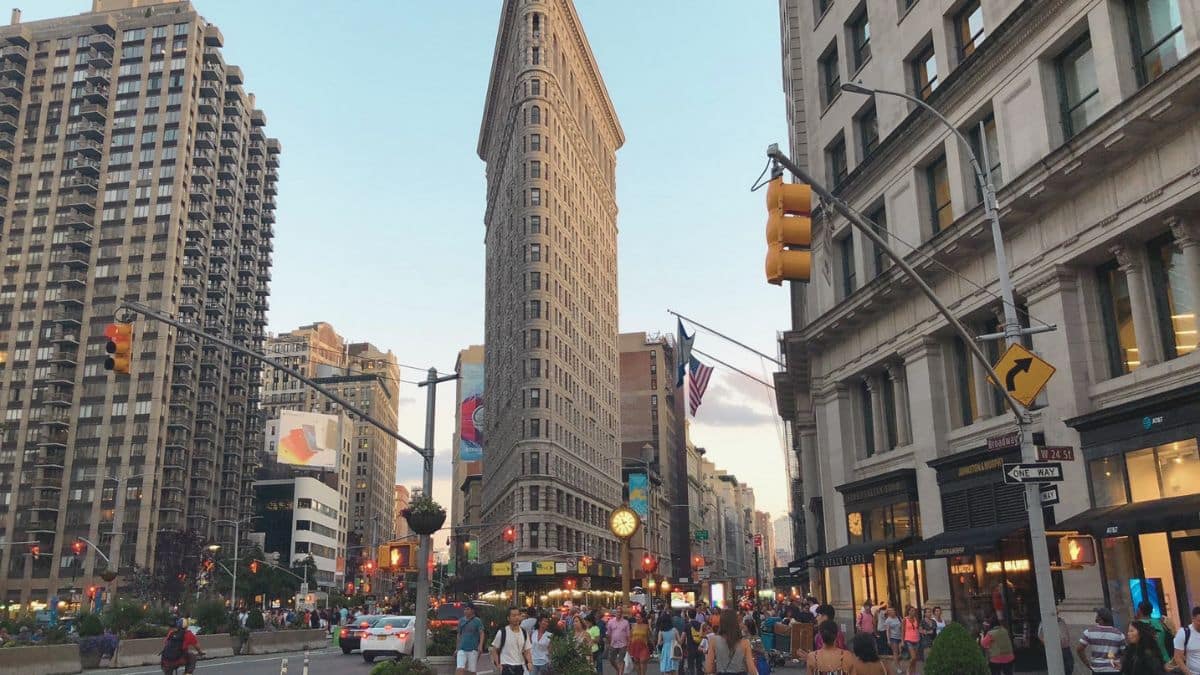

Daniel Hudson Burnham (September 4, 1846 – June 1, 1912) was an American architect, urban planner, and founder of D.H. Burnham & Company — the largest architectural firm in the world at the time of his death. His most enduring New York contribution is the Flatiron Building at 175 Fifth Avenue in the Flatiron District, completed in 1902.
The 22-story, 285-foot steel-framed tower — originally called the Fuller Building — was Burnham's first project in New York City. Its triangular form became so iconic that it gave the entire surrounding neighborhood its name.
| Full name | Daniel Hudson Burnham |
| Born / Died | September 4, 1846 / June 1, 1912 |
| Profession | Architect, urban planner, founder of D.H. Burnham & Company |
| Active in Flatiron | 1901–1904 |
| Known for | Flatiron Building, 1893 World's Columbian Exposition, Plan of Chicago |
| Key Flatiron location | Flatiron Building (originally Fuller Building), 175 Fifth Avenue (completed 1902) |
| Notable legacy | Designed the building that gave the Flatiron District its name and identity |
Who Was Daniel?
Daniel Burnham failed the entrance exams at both Harvard and Yale — and then went on to become the most powerful architect in America. Born in Henderson, New York in 1846 and raised in Chicago, he apprenticed under William Le Baron Jenney, the man credited with inventing the skyscraper, before forming his own partnership with John Wellborn Root in 1873.
Burnham & Root produced nearly 300 structures in 18 years, including the Masonic Temple Building in Chicago — at 21 stories and 302 feet, the tallest building in the world when it was completed.
After Root’s sudden death from pneumonia in 1891, Burnham took sole command and directed the construction of the 1893 World’s Columbian Exposition in Chicago, the largest world’s fair ever staged at that time. That project made Burnham a national figure and launched the City Beautiful movement, which reimagined American cities as places of grandeur, parks, and classical architecture.
His famous maxim — “Make no little plans; they have no magic to stir men’s blood” — became the unofficial motto of an entire generation of builders. By the turn of the century, Burnham’s ambitions had expanded beyond Chicago. New York was next.
Daniel Hudson Burnham's Connection to the Flatiron District
Burnham’s connection to the Flatiron District is singular and definitive: he designed the building that gave the neighborhood its name.
The Flatiron Building (1902)
In February 1901, Harry S. Black, CEO of the Fuller Company, hired Burnham to design a headquarters building on a narrow triangular lot at the intersection of Fifth Avenue, Broadway, and East 22nd Street. It was Burnham’s first commission in New York City.
Working with designer Frederick P. Dinkelberg, Burnham created a 22-story, 285-foot steel-framed tower at 175 Fifth Avenue — the Flatiron Building. Clad in limestone and glazed terra cotta, the facade was designed as a vertical Renaissance palazzo in the Beaux-Arts style, divided like a classical Greek column into base, shaft, and capital.
The building opened on October 1, 1902. At its narrowest point, the northern “prow” at East 23rd Street is just 6.5 feet wide. The Fuller Company took the 19th floor for its headquarters, but New Yorkers ignored the official name and called it the Flatiron — a reference to its resemblance to a cast-iron clothes iron.
A Building That Named a Neighborhood
The Flatiron Building was so immediately iconic that the entire surrounding area became known as the Flatiron District — a name that persists today. The building was designated a New York City landmark in 1966, added to the National Register of Historic Places in 1979, and named a National Historic Landmark in 1989.
Other New York Work
Burnham also designed the Wanamaker’s Annex at 770 Broadway (1904), a 19-story full-block department store that still stands and now houses office space. He also designed the Gimbels Department Store (1908–1912) in Herald Square. But it is the Flatiron that cemented his place in the city’s architectural history.
Legacy and Impact
Daniel Burnham did something no other architect has done in New York City: he designed a single building so distinctive that it renamed the neighborhood around it. Before the Flatiron Building, this stretch of Fifth Avenue and Broadway was simply part of the Ladies’ Mile shopping district. After 1902, it was — and forever would be — the Flatiron District.
The building also helped establish the area as a creative hub. The penthouse floor, added after completion, became artists’ studios rented to painters and illustrators like Louis Fancher, many of whom contributed to the pulp magazines published in offices below. Photographers including Alfred Stieglitz and Edward Steichen made the building one of the most photographed structures in the world.
Today the Flatiron Building at 175 Fifth Avenue is undergoing conversion to luxury residences. But its silhouette — that impossible wedge slicing through the intersection — remains the defining image of the neighborhood. Walk to the north end of Madison Square Park and you’ll see exactly the same view that Stieglitz captured in 1903.
Daniel Burnham didn't just build a skyscraper in Manhattan — he built the one that gave an entire neighborhood its identity. The Flatiron District exists, by name and by character, because of a single building by a Chicago architect who had never built in New York before. That's a level of impact most architects never achieve in an entire career.
Key Facts Worth Knowing
- In 1902, the Flatiron Building at 175 Fifth Avenue opened at 285 feet tall, making it one of the tallest buildings in New York City and among the first to use a full steel-frame structure with non-load-bearing exterior walls.
- In 1901, when Burnham received the Flatiron commission, it was his first project in New York City — despite already being the most prominent architect in the United States and head of the world's largest architectural firm.
- At its northern apex at East 23rd Street, the Flatiron Building is just 6.5 feet wide — roughly the width of a standard interior door — making it one of the narrowest occupied structures in Manhattan.
- In 1989, the Flatiron Building was designated a National Historic Landmark, joining the Statue of Liberty and Grand Central Terminal as one of fewer than 120 landmarks in all of New York City to hold that distinction.
- By 1912, when Burnham died in Heidelberg, Germany, D.H. Burnham & Company employed hundreds of architects and had completed an estimated $1 billion worth of buildings — the equivalent of roughly $30 billion today.
FIND THEIR LEGACY TODAY
- Flatiron Building, 175 Fifth Avenue (at Broadway and East 23rd Street) — the building that gave the district its name. Currently undergoing conversion to luxury residences. A New York City landmark since 1966.
- 770 Broadway (between 8th and 9th Streets) — Burnham's Wanamaker's Annex (1904), a 19-story department store that still stands and currently houses office space.
- Madison Square Park, north end (Broadway and 23rd Street) — the park that the Flatiron Building faces, offering the most iconic view of Burnham's design.
- Herald Square, 33rd Street and Broadway — site of Burnham's Gimbels Department Store (1908–1912, demolished). The Manhattan Mall now occupies the lot.
Explore More of Flatiron's History
→ Flatiron Building NYC: Why This Landmark Captivates Visitors — the complete guide to the building Burnham designed that gave the district its name
→ Flatiron District Architecture Guide | Iconic NYC Landmarks — how Burnham's Beaux-Arts masterpiece fits into the neighborhood's architectural story
→ Flatiron District History: NYC's Landmark Evolution — the broader historical context that brought Burnham to New York
→ Madison Square Park NYC: What to See, Eat & Do — the park that provides the most iconic vantage point for Burnham's Flatiron Building
→ Ladies Mile Flatiron – NYC's Historic Shopping Corridor Reborn — the shopping district that the Flatiron Building helped transform into the modern Flatiron District
In Plain English
Daniel Burnham (1846–1912) was an American architect and urban planner who designed the Flatiron Building at 175 Fifth Avenue, completed in 1902.
The 22-story steel-framed tower — originally called the Fuller Building — became so iconic that it gave the entire surrounding neighborhood its name: the Flatiron District. Burnham was also the chief architect of the 1893 World's Columbian Exposition in Chicago and is considered a father of the American skyscraper and the City Beautiful movement.
Frequently Asked Questions About Daniel Hudson Burnham
Q: Who designed the Flatiron Building in New York City?
A: The Flatiron Building was designed by Chicago architect Daniel Burnham, working with designer Frederick P. Dinkelberg. Completed in 1902 at 175 Fifth Avenue, the 22-story steel-framed tower was originally called the Fuller Building after the construction company that commissioned it. It was Burnham's first project in New York City.
Q: Why is the Flatiron Building shaped like a triangle?
A: The Flatiron Building's triangular shape was dictated by its lot, which sits at the intersection of Fifth Avenue, Broadway, and East 22nd Street. Broadway cuts diagonally across Manhattan's grid, creating the narrow wedge-shaped plot. Burnham used a steel-frame structure to maximize the usable space on the tight site, resulting in a building just 6.5 feet wide at its narrowest point.
Q: Is the Flatiron Building still standing?
A: Yes. The Flatiron Building at 175 Fifth Avenue still stands and is a designated New York City landmark (1966), listed on the National Register of Historic Places (1979), and a National Historic Landmark (1989). It is currently being converted from office space to luxury residential units.
Q: What else did Daniel Burnham design?
A: Beyond the Flatiron Building, Burnham designed Union Station in Washington, D.C. (1907), the Wanamaker's Annex at 770 Broadway in New York (1904), and the Rookery and Monadnock buildings in Chicago. He was also the chief architect of the 1893 World's Columbian Exposition and co-authored the 1909 Plan of Chicago, the first comprehensive master plan for an American city.
Q: What is the Flatiron District named after?
A: The Flatiron District is named after the Flatiron Building at 175 Fifth Avenue, designed by Daniel Burnham and completed in 1902. The building's triangular shape resembled a cast-iron clothes iron, and New Yorkers began calling it the "Flatiron" almost immediately. The nickname spread to the surrounding neighborhood and became its official name.