
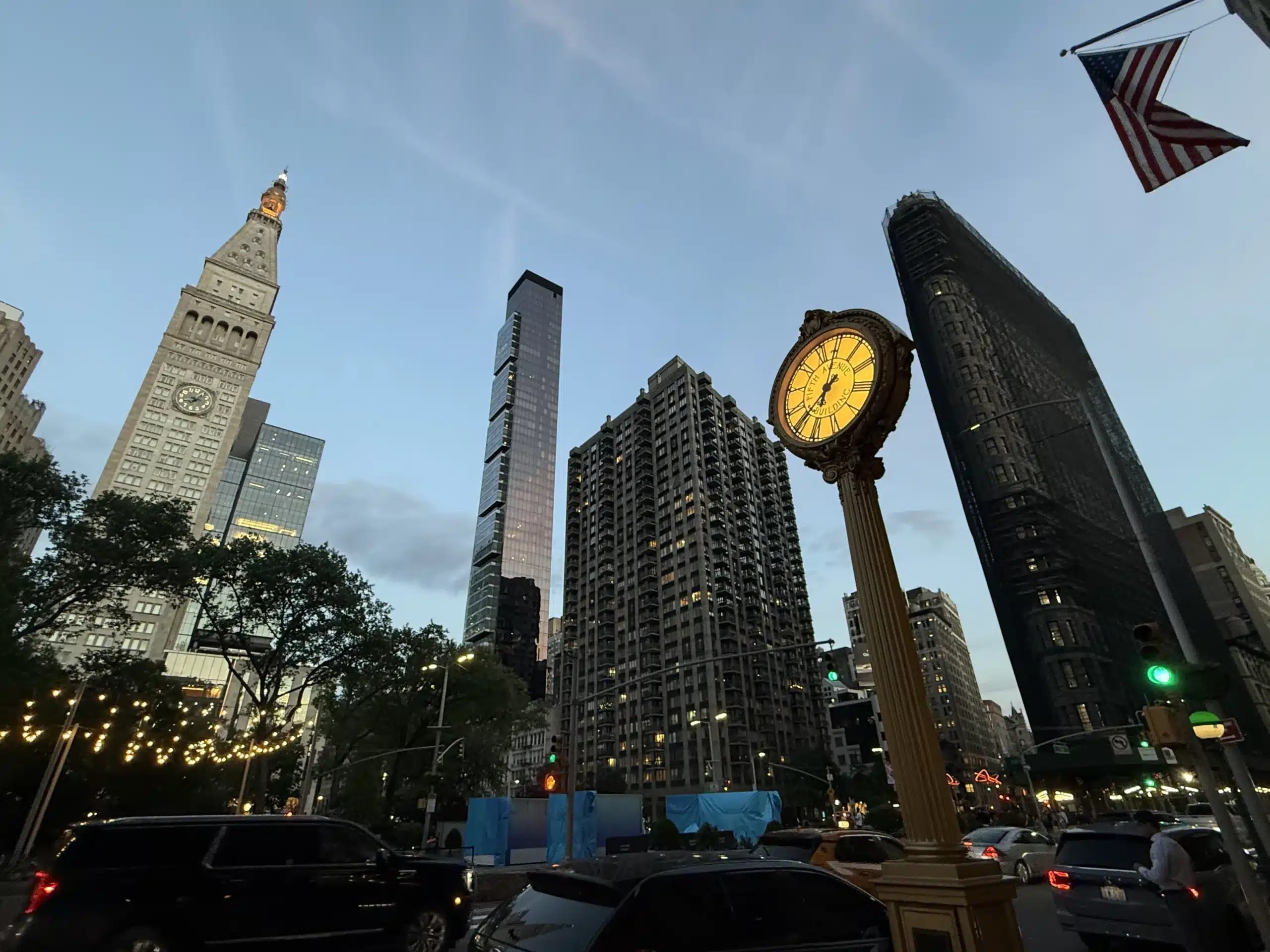
Nikola Tesla (July 10, 1856 – January 7, 1943) was a Serbian-American inventor who transformed modern civilization through his work on alternating current power systems. During his most productive years, Tesla operated laboratories in and around the Flatiron District, conducting experiments that revolutionized electricity and wireless communication. His work in Manhattan during the 1880s and 1890s laid the foundation for the electrical infrastructure powering New York City today.
Tesla's primary laboratory at 33-35 South Fifth Avenue (now LaGuardia Place) served as his main research facility from 1886 until fire destroyed it in 1895. In 1898, he stunned audiences at the original Madison Square Garden at 26th Street and Madison Avenue by demonstrating the world's first radio-controlled boat. The AC induction motor he patented while working in Manhattan now powers everything from subway cars to refrigerators.
| Full name | Nikola Tesla |
| Born / Died | July 10, 1856 / January 7, 1943 |
| Profession | Inventor, electrical engineer, and pioneer of alternating current (AC) power systems |
| Active in Flatiron | c. 1886–1902 |
| Known for | Alternating current (AC) electrical systems, Tesla coil, first public radio-controlled demonstration at Madison Square Garden |
| Key Flatiron location | Tesla's South Fifth Avenue Laboratory, 33-35 South Fifth Avenue (now LaGuardia Place), 1886–1895, destroyed by fire |
| Notable legacy | Tesla's AC motor patents, developed in his Manhattan laboratories, power the NYC subway system and virtually every electrical device in the modern world. |
Who Was Nikola?
Nikola Tesla arrived in New York City in 1884 with four cents in his pocket, a letter of introduction to Thomas Edison, and a head full of ideas that would change the world. Born in Smiljan, in the Austrian Empire (modern-day Croatia), Tesla had trained as an electrical engineer in Europe before crossing the Atlantic to pursue his vision of alternating current power.
The Brilliant Outsider
Tesla briefly worked for Edison, but the two men clashed over the future of electricity. Edison championed direct current (DC); Tesla believed AC was superior. He was right. By 1888, Tesla had partnered with industrialist George Westinghouse and patented the AC induction motor (U.S. Patent 381,968)—the same fundamental technology that runs the New York City subway system today.
A Mind Unlike Any Other
Colleagues described Tesla as obsessive, eccentric, and possessed of an almost supernatural ability to visualize complex machines in his mind before ever building them. He claimed to see blinding flashes of light when ideas struck him. He was fastidious about cleanliness, counted his steps compulsively, and refused to shake hands with anyone.
Tesla became a naturalized U.S. citizen in 1891, cementing his identity as an American inventor at the peak of his creative powers. By the time of his death in 1943, he held over 300 patents. He had imagined technologies—from wireless power transmission to smartphone-like communication devices—that wouldn’t become reality for another century. Today, visitors can explore the era Tesla helped define on a Flatiron District walking tour.
Nikola Tesla's Connection to the Flatiron District
Tesla’s most productive years unfolded in the blocks surrounding Madison Square, where his laboratories, social haunts, and public demonstrations defined an era of electrical innovation.
The South Fifth Avenue Laboratory (1886–1895)
Tesla’s primary research facility occupied 33-35 South Fifth Avenue, a building just south of Washington Square at the border of what is now considered the Flatiron District and Greenwich Village [VERIFY exact historic district boundaries]. Here, Tesla developed his polyphase AC system, conducted early experiments in wireless transmission, and refined the Tesla coil that would enable radio technology.
The laboratory was packed with coils, oscillators, and experimental equipment worth approximately $50,000—equivalent to roughly $1.8 million today. On March 13, 1895, fire swept through the building, destroying years of research, notes, and irreplaceable prototypes. Thomas Commerford Martin, editor of Electrical Engineer, called it “a calamity to the whole scientific world.”
The Madison Square Garden Demonstration (1898)
Tesla stunned audiences at the original Madison Square Garden at 26th Street and Madison Avenue when he publicly demonstrated a radio-controlled boat in 1898. He called the device a “teleautomaton”—a boat that responded to wireless commands from across the arena. Spectators suspected trickery or telepathy. In reality, they were witnessing the birth of remote control technology.
The Stanford White-designed arena, completed in 1890, was the perfect stage for Tesla’s theatrical demonstrations. The building was demolished in 1925; the New York Life Building now occupies the site.
Social Life Around Madison Square
Tesla was a fixture at Delmonico’s restaurant, which operated a location near 26th Street and Fifth Avenue during the 1890s [VERIFY exact address]. He dined there nearly every evening for over two decades, always at the same table, where he would calculate the cubic volume of his food before eating.
He also frequented The Players Club at 16 Gramercy Park South, where he mingled with actors, writers, and fellow visionaries. In 1894, Tesla reportedly photographed his friend Mark Twain using phosphorescent light at his South Fifth Avenue laboratory—one of the earliest photographs lit by artificial fluorescent illumination [VERIFY exact date and whether photo still exists].
Legacy and Impact
Tesla’s work in the Flatiron District area didn’t just advance science—it created the modern world.
The AC power systems he developed while working in Manhattan now deliver electricity to billions of people worldwide. Every time a New Yorker rides the subway, flips a light switch, or charges a phone, they’re using technology rooted in Tesla’s 1888 patents. His 1898 radio-controlled boat demonstration at Madison Square Garden laid the groundwork for everything from television remotes to military drones.
What Visitors Can Experience Today
The site of Tesla’s South Fifth Avenue laboratory is now part of NYU’s campus, with modern buildings where his workshop once stood. Madison Square Park remains a green oasis at the heart of the neighborhood, though the original Madison Square Garden has been replaced by the New York Life Building at 26th Street and Madison Avenue (completed 1928).
The Players Club at 16 Gramercy Park South still operates as a private club, preserving the kind of intellectual atmosphere Tesla once enjoyed. An honorary street sign at the corner of 40th Street and Sixth Avenue designates “Nikola Tesla Corner”—a small tribute to a man whose ideas were too big for any single neighborhood to contain.
Tesla died in 1943 at the New Yorker Hotel, largely forgotten and nearly penniless. Today, his name adorns one of the world’s most valuable companies, and his vision of wireless power transmission no longer seems like science fiction.
Tesla didn't just invent things—he invented the future. The same man who demonstrated radio control to gasping Victorian crowds at Madison Square Garden also predicted smartphones, wireless internet, and renewable energy. Walk through the Flatiron District today and you're walking through the neighborhood that incubated the technology running your entire life.
Key Facts Worth Knowing
- 1895: A fire at Tesla's laboratory at 33-35 South Fifth Avenue destroyed equipment, notes, and prototypes worth $50,000—approximately $1.8 million in today's dollars.
- 1898: Tesla demonstrated the world's first radio-controlled boat at Madison Square Garden, calling it a "teleautomaton"—spectators believed he was using telepathy.
- 1888: Tesla received U.S. Patent 381,968 for his AC induction motor while working in Manhattan—the same technology that powers the NYC subway system today.
- Over two decades, Tesla dined at Delmonico's restaurant nearly every evening at the same table, where he would calculate the cubic volume of each dish before eating it.
- 1891: Tesla became a naturalized U.S. citizen while living in Manhattan—the same year he patented the Tesla coil that enabled wireless transmission experiments.
FIND THEIR LEGACY TODAY
- 33-35 South Fifth Avenue (now LaGuardia Place), near Washington Square — Site of Tesla's primary laboratory from 1886–1895. Destroyed by fire on March 13, 1895. Now part of NYU's campus with modern buildings occupying the site.
- Original Madison Square Garden, 26th Street and Madison Avenue — Tesla demonstrated his radio-controlled boat here in 1898. Demolished 1925. The New York Life Building (completed 1928) now occupies the site and is a NYC Landmark.
- The Players Club, 16 Gramercy Park South — Tesla was a member of this private social club at the southern edge of the Flatiron area. Still operating today. NYC Landmark and National Historic Landmark.
- Nikola Tesla Corner, 40th Street and Sixth Avenue — Honorary street sign designated in Tesla's honor in 1994. Still exists as an honorary designation.
Explore More of Flatiron's History
→ Flatiron District History: NYC's Landmark Evolution — Context for the era when Tesla operated his laboratories and conducted experiments in the neighborhood.
→ Madison Square Park NYC: What to See, Eat & Do (2025) — Tesla frequented Madison Square for social and professional engagements; the original Madison Square Garden hosted his 1898 demonstration.
→ New York Life Building – A Gilded Icon of NYC History — This building now occupies the site where Tesla demonstrated his radio-controlled boat at the original Madison Square Garden.
→ Flatiron District Walking Tour – Historic NYC Landmarks — Walk past sites connected to Tesla's era, including Madison Square Park and the New York Life Building.
→ Flatiron District Architecture Guide | Iconic NYC Landmarks — Explores the architectural heritage of buildings Tesla would have known during his years in the neighborhood.
In Plain English
Nikola Tesla (1856–1943) was a Serbian-American inventor and electrical engineer who pioneered alternating current (AC) power systems while working in laboratories near New York City's Flatiron District. His primary laboratory at 33-35 South Fifth Avenue operated from 1886 until a fire destroyed it in 1895. In 1898, Tesla demonstrated the world's first radio-controlled boat at the original Madison Square Garden at 26th Street and Madison Avenue. The AC induction motor he patented in Manhattan now powers the NYC subway system and most electrical devices worldwide.
Frequently Asked Questions About Nikola Tesla
Q: What did Nikola Tesla invent?
A: Tesla invented the alternating current (AC) induction motor, the Tesla coil, and pioneered wireless transmission technology. He demonstrated the world's first radio-controlled device at Madison Square Garden in 1898. His AC power system, developed while working in Manhattan laboratories, now delivers electricity to billions of people worldwide and powers the NYC subway system.
Q: Where did Nikola Tesla live and work in New York City?
A: Tesla operated his primary laboratory at 33-35 South Fifth Avenue (now LaGuardia Place) near the Flatiron District from 1886 to 1895. After a fire destroyed that facility, he rebuilt at 46 East Houston Street before moving to other locations in Manhattan. He frequented Delmonico's restaurant near Madison Square and was a member of The Players Club at 16 Gramercy Park South. He died at the New Yorker Hotel in 1943.
Q: What happened between Tesla and Edison?
A: Tesla briefly worked for Thomas Edison in 1884, but the two inventors clashed over the future of electricity. Edison championed direct current (DC), while Tesla believed alternating current (AC) was superior. Tesla left Edison's company and eventually partnered with George Westinghouse. The "War of Currents" ended with Tesla's AC system becoming the global standard for electrical power.
Q: Why did Nikola Tesla die poor?
A: Tesla spent much of his later fortune on ambitious projects like Wardenclyffe Tower, a wireless transmission facility on Long Island that was never completed. He also gave up valuable royalty rights to Westinghouse during a financial crisis. By the time of his death in 1943, Tesla was living modestly at the New Yorker Hotel, largely forgotten by the public despite his revolutionary contributions.
Q: Did Tesla invent the radio?
A: Tesla made fundamental contributions to radio technology, including patents filed before Guglielmo Marconi's famous demonstrations. In 1943, the U.S. Supreme Court upheld Tesla's radio patents, posthumously recognizing his priority in key radio innovations. Tesla demonstrated radio control technology at Madison Square Garden in 1898, years before radio broadcasting became widespread.