
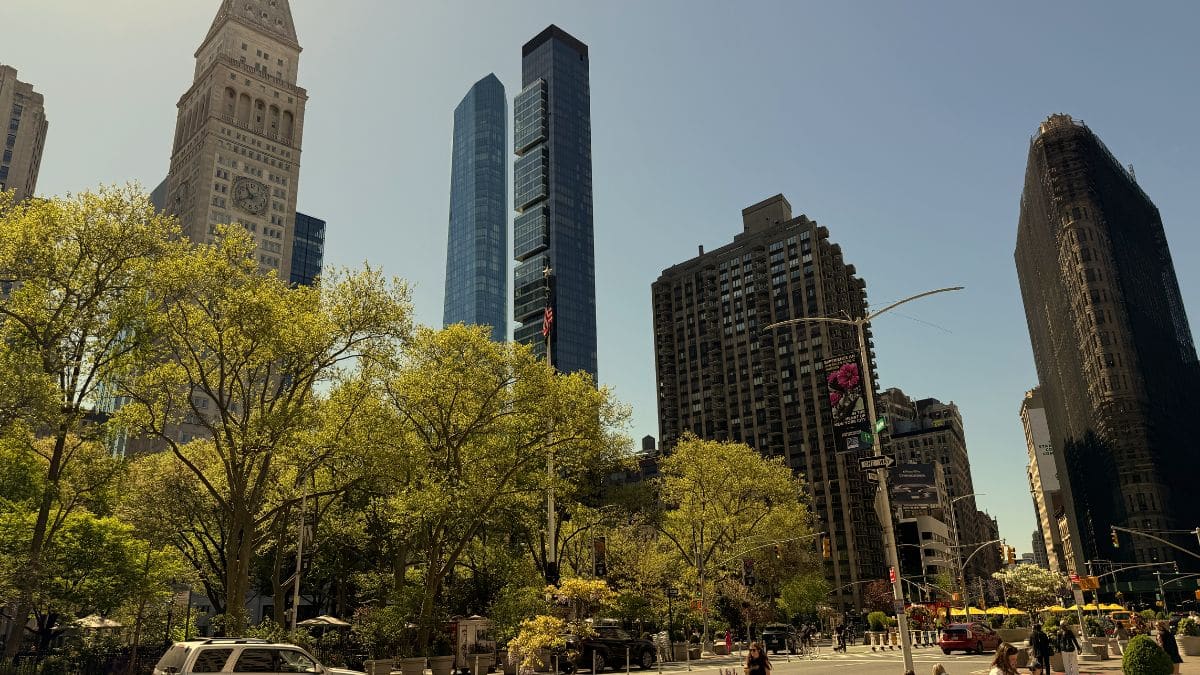

Roscoe Conkling (1829–1888) was one of the most powerful U.S. Senators of the Gilded Age and a dominant force in New York machine politics. His dramatic death following the Great Blizzard of 1888 occurred in the Flatiron District, where he collapsed in a snowdrift near Madison Square after attempting to walk from Wall Street through the storm.
A bronze statue of Conkling by sculptor John Quincy Adams Ward was unveiled in Madison Square Park in 1893, directly overlooking the approximate location where he fell. Today, visitors to the park walk past this monument—one of the few memorials in New York honoring a politician who literally gave his life trying to conquer the city's streets.
| Full name | Roscoe Conkling |
| Born / Died | October 30, 1829 / April 18, 1888 |
| Profession | U.S. Senator, Republican Party leader, corporate attorney |
| Active in Flatiron | c. 1881–1888 |
| Known for | Leader of the "Stalwart" faction of the Republican Party, only person to decline a confirmed U.S. Supreme Court nomination, death following the Great Blizzard of 1888 |
| Key Flatiron location | Madison Square Park, Broadway and 23rd Street, 1888 — site of his collapse during the Great Blizzard and location of his memorial statue (unveiled 1893). EXISTS · LANDMARKED. |
| Notable legacy | His dramatic death during the Great Blizzard of 1888 became one of the most famous stories in New York City history, and his bronze statue in Madison Square Park has memorialized his connection to the Flatiron District for over 130 years. |
Who Was Roscoe?
Roscoe Conkling was the closest thing the Gilded Age had to a political celebrity. Standing 6 feet 3 inches tall with a distinctive reddish-blond “Hyperion curl” in his hair, he was frequently compared to a Greek god by contemporaries—and he clearly didn’t mind the comparison.
From Albany to Washington
Born in Albany, New York in 1829, Conkling rose rapidly through the legal and political ranks. He served in the U.S. House of Representatives before winning election to the U.S. Senate in 1867, where he would dominate New York politics for over a decade. His career unfolded during the same era that transformed the Flatiron District from farmland into a commercial powerhouse.
The Stalwart Boss
As leader of the “Stalwart” faction of the Republican Party, Conkling controlled the New York Customs House—which in 1880 collected over 70% of all U.S. import duties and employed more than 1,000 political appointees loyal to his machine. His protégé Chester A. Arthur became President in 1881 after James Garfield’s assassination.
A Pride That Defined Him
Conkling’s legendary pride was both his greatest asset and his downfall. In 1882, he became the only person in American history to decline a confirmed nomination to the U.S. Supreme Court, refusing the seat offered by President Arthur. He had already resigned from the Senate in 1881 over a patronage dispute—a gamble that backfired when the New York legislature refused to reelect him.
After leaving politics, he established a spectacularly lucrative law practice in New York City, earning over $100,000 annually (roughly $3 million today). He represented clients including Jay Gould and the Southern Pacific Railroad, frequenting the Ladies’ Mile commercial district that defined Gilded Age Manhattan.
Roscoe Conkling's Connection to the Flatiron District
Roscoe Conkling’s connection to the Flatiron District is written in bronze and tragedy. His final act of stubborn defiance—attempting to walk through the deadliest blizzard in New York history—ended just steps from Madison Square.
The Fatal Walk: March 12, 1888
On the morning of March 12, 1888, Conkling left his Wall Street office as the Great Blizzard descended on New York City. The March weather that year was catastrophic—the storm would kill over 400 people across the Northeast. Rather than wait it out, the 58-year-old former senator decided to walk approximately three miles uptown to his rooms at the Hoffman House Hotel at 1114 Broadway (between 24th and 25th Streets). The journey that normally took 30 minutes took nearly three hours.
Collapse at Madison Square
Conkling made it as far as Union Square, then continued north through drifts that reached his waist. Near Madison Square, at approximately 25th Street and Broadway, he collapsed in a snowdrift. He was found nearly unconscious and carried into the nearby New York Club at 12 West 25th Street [VERIFY exact rescue location], where he was revived.
The Hoffman House: His Gilded Age Headquarters
The Hoffman House Hotel, where Conkling maintained rooms and conducted political business throughout the 1880s, was itself a Flatiron District legend. Located at 1114 Broadway, it featured a famously controversial 10-foot-wide painting of nude nymphs by William-Adolphe Bouguereau that made its bar one of the most talked-about gathering spots in the city. The hotel was demolished in 1915.
Death and Memorial
Conkling never recovered from his blizzard exposure. He developed pneumonia and mastoiditis—an infection that spread to his brain—and died on April 18, 1888. Five years later, in 1893, a bronze statue by sculptor John Quincy Adams Ward was unveiled among the Madison Square Park monuments, directly overlooking the approximate location where Conkling fell. The statue stands today near the intersection of Broadway and 23rd Street, on the park’s east side near 26th Street.
Legacy and Impact
Roscoe Conkling’s death transformed him from a controversial political boss into a romantic figure—the powerful man brought low by his own stubborn pride, refusing to yield even to nature itself.
A Monument to Defiance
His statue in Madison Square Park, sculpted by John Quincy Adams Ward (the same artist who created the George Washington statue at Federal Hall), remains one of the most significant political monuments in the Flatiron District. Unlike most civic memorials, it commemorates not a victory but a defeat—a man who tried to walk through a blizzard and lost.
The Great Blizzard of 1888 killed over 400 people in the Northeast and paralyzed New York City for days. Conkling’s story became the storm’s most famous human casualty, retold in newspapers and history books for over a century.
What Visitors Can Experience Today
Today, visitors to Madison Square Park can stand before Conkling’s bronze likeness and look south toward the approximate location of his collapse. The Hoffman House is gone, replaced by modern commercial buildings. The New York Club has been demolished. But the park itself—and Conkling’s eternally defiant gaze—endures.
There's something almost novelistic about Roscoe Conkling's death—the arrogant senator, too proud to hail a cab, walking three miles through a blizzard because he refused to be defeated by weather. His statue in Madison Square Park isn't a celebration of political achievement. It's a monument to stubbornness. And in a city that rewards persistence above all else, that might be the most New York memorial of all.
Key Facts Worth Knowing
- 1882: Roscoe Conkling became the only person in American history to decline a confirmed nomination to the U.S. Supreme Court after being approved by the Senate.
- $100,000 per year—roughly $3 million in today's dollars—was Conkling's annual income as a corporate lawyer in the 1880s, representing clients including Jay Gould and the Southern Pacific Railroad.
- 3 hours—the time it took Conkling to walk from Wall Street to Madison Square during the Great Blizzard of 1888, a journey that normally required 30 minutes.
- 1880: The New York Customs House controlled by Conkling's machine collected over 70% of all U.S. import duties and employed more than 1,000 political appointees.
- 1893: Conkling's bronze statue by sculptor John Quincy Adams Ward was unveiled in Madison Square Park—just five years after his death and overlooking the spot where he collapsed.
FIND THEIR LEGACY TODAY
- Madison Square Park, Broadway and 23rd Street (east side near 26th Street) — Look for the bronze statue of Conkling by John Quincy Adams Ward, unveiled 1893. This is approximately where he collapsed during the blizzard and his most enduring Flatiron memorial. EXISTS · LANDMARKED.
- Former Hoffman House Hotel, 1114 Broadway (between 24th and 25th Streets) — Where Conkling maintained rooms and conducted political business. The hotel, famous for its scandalous nude painting, was demolished in 1915. A modern commercial building occupies the site.
- Former New York Club, 12 West 25th Street — Where Conkling was reportedly rescued after collapsing in the snowdrift [VERIFY exact rescue location]. The original clubhouse no longer exists. DEMOLISHED.
- Madison Square (general), bounded by 23rd Street, 26th Street, Fifth Avenue, and Madison Avenue — The broader area where Conkling's fatal walk ended. The park and surrounding streets remain largely unchanged in layout since 1888. EXISTS · LANDMARKED.
Explore More of Flatiron's History
→ Madison Square Park Monuments: The Stories New Yorkers Walk Past Every Day — Conkling's statue is one of the most historically significant monuments in the park, honoring his dramatic death during the Great Blizzard of 1888.
→ Madison Square Park NYC: What to See, Eat & Do (2025) — A complete guide to the park where Conkling's statue stands and where his fatal blizzard walk ended.
→ Flatiron District History: NYC's Landmark Evolution — Conkling's story is part of the Gilded Age history that shaped the Flatiron District into the neighborhood it is today.
→ Flatiron District Walking Tour – Historic NYC Landmarks — Visitors can follow a route past Madison Square Park and see Conkling's statue as part of a broader historical walking tour.
→ Madison Square Park Art: The Changing Gallery New Yorkers Walk Through Daily — The park's permanent monuments, including Conkling's statue, provide historical context alongside the rotating contemporary art installations.
In Plain English
Roscoe Conkling (1829–1888) was a U.S. Senator from New York and one of the most powerful Republican Party bosses of the Gilded Age. His connection to the Flatiron District stems from his dramatic death following the Great Blizzard of 1888, when he collapsed in a snowdrift near Madison Square after attempting to walk from Wall Street through the storm. A bronze statue of Conkling by sculptor John Quincy Adams Ward stands in Madison Square Park today, near the location where he fell.
Frequently Asked Questions About Roscoe Conkling
Q: How did Roscoe Conkling die?
A: Roscoe Conkling died on April 18, 1888, from mastoiditis—an infection that spread to his brain—after being exposed to the Great Blizzard of March 1888. He had collapsed in a snowdrift near Madison Square after attempting to walk from Wall Street through the storm. He was rescued and taken to shelter but never fully recovered, developing pneumonia and the fatal ear infection that killed him five weeks later.
Q: Where is the Roscoe Conkling statue in New York?
A: The Roscoe Conkling statue stands in Madison Square Park in Manhattan's Flatiron District, near the intersection of Broadway and 23rd Street on the park's east side (closer to 26th Street). The bronze sculpture by John Quincy Adams Ward was unveiled in 1893, approximately five years after Conkling's death and near the location where he collapsed during the blizzard.
Q: Why did Roscoe Conkling refuse the Supreme Court?
A: In 1882, Roscoe Conkling declined a confirmed nomination to the U.S. Supreme Court offered by President Chester Arthur—making him the only person in American history to refuse after Senate approval. While his exact reasons were never publicly stated, historians believe Conkling's enormous income from his corporate law practice (over $100,000 annually) and his distaste for judicial work made the position unappealing compared to his lucrative legal career.
Q: What happened to Roscoe Conkling in the Blizzard of 1888?
A: On March 12, 1888, Roscoe Conkling attempted to walk approximately three miles from Wall Street to his rooms at the Hoffman House Hotel near Madison Square during the Great Blizzard. The journey took nearly three hours through waist-high drifts. He collapsed near 25th Street and Broadway and was rescued, but the exposure led to pneumonia and mastoiditis, killing him on April 18, 1888.
Q: Who were the Stalwarts led by Roscoe Conkling?
A: The Stalwarts were a faction of the Republican Party during the Gilded Age, led by Roscoe Conkling and based primarily in New York. They supported the spoils system of political patronage and opposed civil service reform. The Stalwarts' most notable protégé was Chester A. Arthur, who became President in 1881 after James Garfield's assassination. The faction lost power after Conkling resigned from the Senate in 1881 and failed to win reelection.