

The Flatiron District history is a story of transformation. Can you imagine how a single triangular block at 23rd Street, where Broadway cuts dramatically across Fifth Avenue, helped define the skyline and spirit of modern New York City?
Growing around the beauty of Madison Square Park, the Flatiron District history evolved from elegant promenades and grand department stores into a hub of architectural innovation and cultural energy.
For visitors who want to experience this history firsthand, here are some of the best places to stay in Flatiron, all within walking distance of these landmarks.
✨ Highlights – Flatiron District NYC
🏛 Snap a pic at the iconic Flatiron Building
🥐 Eat your way through Eataly, Shake Shack & more
🌳 Relax in Madison Square Park or hit rooftop bars
🎟️ Explore museums, pop-ups & nearby attractions
Quick Flatiron District History Timeline:
| Year | Event | Significance |
|---|---|---|
| Early 1800s | Area is rural farmland | Pre-urban era; north of the city limits |
| 1839 | Madison Cottage opens | Popular roadhouse; precursor to Fifth Avenue Hotel |
| 1853 | Franconi’s Hippodrome is built | First major entertainment venue in the area |
| 1859 | Fifth Avenue Hotel opens | One of NYC’s first luxury hotels; hosted dignitaries |
| 1870s–1890s | Ladies’ Mile retail boom | Beginning of high-end shopping corridor |
| 1902 | Flatiron Building is completed | NYC icon; kickstarts early skyscraper era |
| 1909 | MetLife Tower completed | It was briefly tallest building in the world |
| 1913 | Appellate Courthouse completed | Adds Beaux-Arts civic presence |
| 1928 | New York Life Building completed | Symbol of financial growth; iconic gilded pyramid added to the skyline |
| Mid-1900s | Area shifts to commercial offices | Decline in residential occupation, rise in office spaces |
| 1989 | Ladies’ Mile Historic District designated | Preserves architecture of 19th-century department stores |
| 1997 | Flatiron/23rd Street Partnership founded | First BID to lead neighborhood revitalization |
| 2009 | Flatiron Public Plazas introduced | Renewed pedestrian life at 23rd & Broadway |
| 2016 | MetLife Tower lights restored | Local appreciation for architectural landmarks |
| 2022 | BID renamed Flatiron NoMad Partnership | Reflects stronger connection with NoMad district |
| Present Day | Flatiron becomes cultural + tech hotspot | Blend of historic charm and modern innovation |
How the Grid Made a Neighborhood
Before the name “Flatiron District,” Broadway was breaking the rules by slicing diagonally through Manhattan’s grid, creating those signature triangular intersections that make this part of the city so iconic.
Flatiron’s unusual geometry invited experimentation with fresh building forms, dramatic sightlines, and eventually, the kind of intimate public plazas that now feel inseparable from New York’s everyday rhythm.
This wedge of Manhattan quickly became a public promenade for the city’s growing middle and upper classes. On any given Sunday, New Yorkers strolled park’s shaded paths, while traffic moved briskly along Fifth Avenue.
The Fifth Avenue Hotel, one of NYC’s first luxury hotels, anchored the neighborhood as a social and political stage, decades before Times Square even came into being.
The Beginning: Madison Square Garden and the Culture Around It
Just north of the park, the original Madison Square Garden turned the residential neighborhood into a magnet for spectacle.
From circuses and boxing matches to political rallies and music performances, it was a place where New York came to see and be seen.
That tradition of showmanship left a permanent imprint. Today, Flatiron still hums with that same cultural curiosity. It is currently home to the National Museum of Mathematics, the Museum of Sex, and the Rubin Museum of Art, all within a short walking distance.
The Naming: Construction of the Flatiron Building (The Fuller Building)
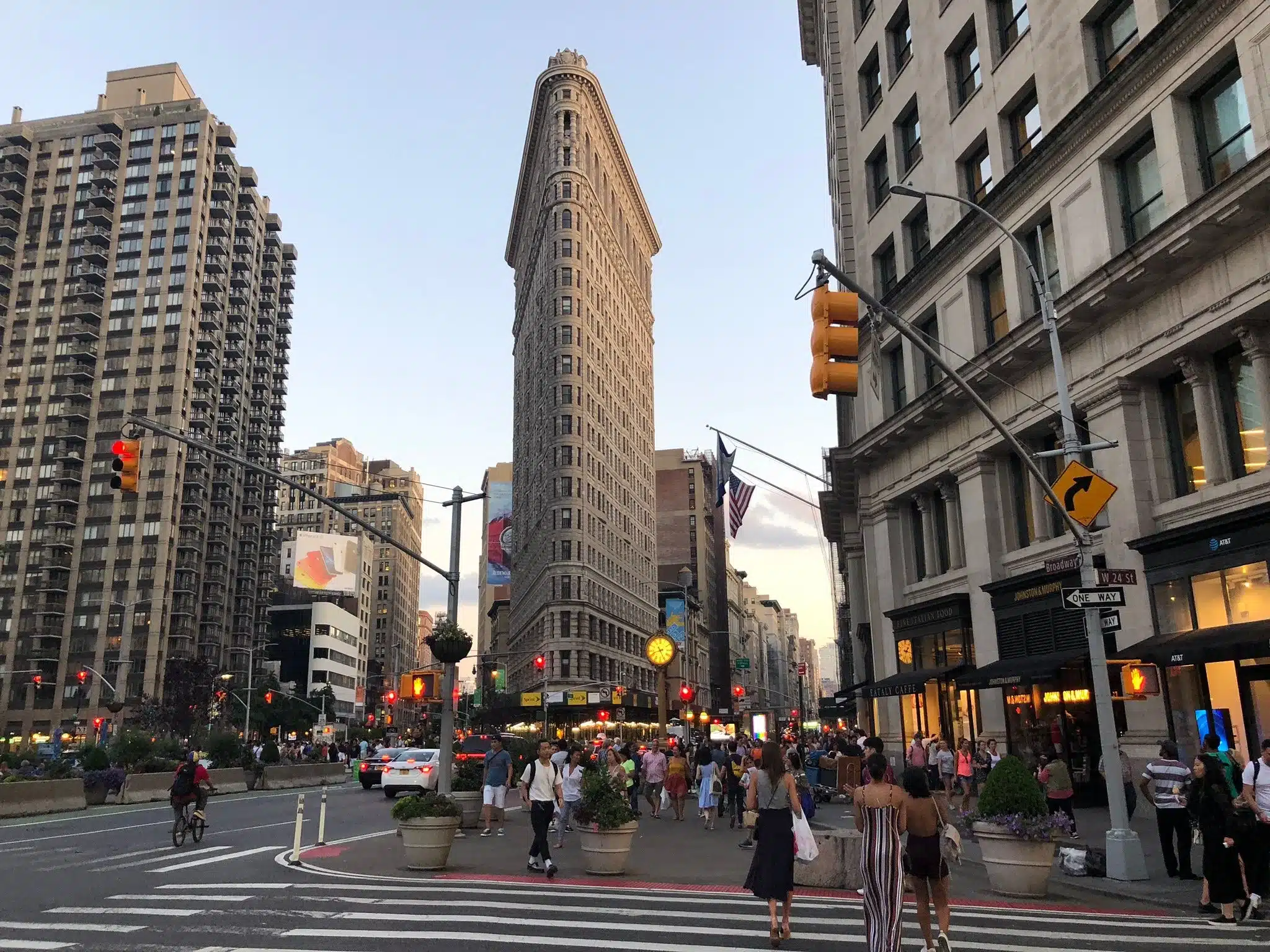
In 1902, when ambition met opportunity, Architect Daniel Burnham and George A. Fuller Company secured the iconic triangular parcel where Broadway and Fifth Avenue intersect at 23rd Street.
A steel-framed skyscraper rising like the prow of a ship cutting through Manhattan’s urban current, The Flatiron Building’s daring form captivated New Yorkers immediately. Its official name, the Fuller Building, never stuck.
The nickname “Flatiron” captured the city’s imagination, and before long, it gave its name to the entire neighborhood.
The Development: Retail Bloom: Ladies’ Mile, Flagship Stores, and Specialty Shops
By the late 19th century, Broadway and Sixth Avenue had become a retail paradise known as “Ladies’ Mile.” Towering department stores and ornate cast-iron buildings lined the streets, beneath the street level, basement bargains awaited savvy shoppers who made the trip.
Around 200 Fifth Avenue, the area became known as the Toy District, where toy companies transformed elegant commercial buildings into showrooms for the American International Toy Fair. For one week each year, buyers from around the world filled Flatiron’s streets.
As activities shifted uptown toward Rockefeller Center and Fifth Avenue’s luxury boutiques, Flatiron adapted. Those same wide, sunlit floors that once displayed fashion now became loft offices and creative studios. An example of how New York’s heritage can evolve without erasing its past.
Continuing History: Insurance Giants Frame the Park
Corporate headquarters defined the park’s skyline in the early 1900s. The Metropolitan Life Insurance Company raised the Met Life Tower on Madison Avenue, a campanile-style clock tower that briefly held the title of tallest building in the United States.
To the north, the New York Life Insurance Company crowned its new building with a gilded pyramid, a neo-Gothic counterpoint to Met Life’s lantern.
Then the Great Depression checked New York’s super-tall ambitions. The Metropolitan Life North Building at 11 Madison Avenue, engineered to carry a much taller addition, never received its crown.
Flatiron District History Continues: The Way Back to a Must-Visit Destination
Mid-century, big retail floated north, and some commercial corridors quieted. Madison Square Park had a rough patch. Yet the surrounding neighborhood kept working!
By the 1990s and 2000s, a different idea took hold: restore the park’s green spaces, add public art, carve out public spaces at the Flatiron triangle on 23rd Street, and make people feel welcome to stay.
Food trucks and specialty shops followed; local businesses returned to the ground floor; community events multiplied; and local experts began offering walking tours that stitched history to street life.
Walk the Flatiron District History (45–75 Minutes)
Begin at the central lawn of Madison Square Park, where the city’s architectural timeline reveals itself in every direction. Slowly take in the Met Life Tower to the east, the Flatiron Building at the southwest corner, and the New York Life Building’s golden pyramid crowning the north.
Then walk toward the Flatiron triangle at 23rd Street for the classic photo of the building’s razor-thin edge. Turn slightly to find the cast-bronze Fifth Avenue clock and continue up Madison Avenue to 11 Madison Avenue (the Metropolitan Life North Building).
From there, angle north toward the New York Life Building, its gilded roof catching afternoon light like a compass point. Loop back along Park Avenue South and East 22nd Street for a quieter close near Gramercy Park, where tree-lined streets trade skyscrapers for wrought-iron fences.
If you’re in the mood for more energy, Union Square’s market buzzes just blocks away; wander further and you’ll find Greenwich Village’s café corners and late-night jazz spilling into the streets.
Optional detours keep the walk fresh: explore clever geometry at MoMath, curiosity at the Museum of Sex, introspection at the Rubin Museum of Art, or craftsmanship at NY Cake on West 22nd Street.
Closing Snapshot — The Living Geometry of Manhattan
The Flatiron District’s story isn’t just about architecture or planning; it’s about how New York learned to turn constraint into character. Out of that strange geometry rose a building that defied convention, a park that invited connection, and a neighborhood that never stopped reinventing itself.
Walk its streets today and you can feel that conversation between past and present. The same grid that once seemed rigid still makes room for everyday surprises. Every block tells the same truth: New York’s greatness comes not from its edges, but from learning how to live beautifully within them.
The Flatiron District endures because it embodies what the city does best: adapting, performing, and celebrating the improbable.
It is proof that history, when lived, can still stop us mid-stride, make us look up, and remind us why we fell in love with New York in the first place.
Meet the People Who Built the Flatiron District
Behind every triangular street corner and gilded pyramid is a person who made the choice. The architects who drew the skyline. The artists who turned the neighborhood into images. The writers who chronicled it. The reformers who fought to make it better.
Behind every triangular street corner and gilded pyramid is a person who made the choice. The architects who drew the skyline. The artists who turned the neighborhood into images. The writers who chronicled it. The reformers who fought to make it better.
From Daniel Burnham, the Chicago visionary who designed the Flatiron Building in 1902, to Edith Wharton, born on West 23rd Street and winner of the first Pulitzer Prize awarded to a woman — every notable figure who shaped this neighborhood now has a full biography in our comprehensive guide.
→ Explore Notable People of the Flatiron District — featuring biographies of architects, artists, writers, business leaders, and reformers who left their mark on the streets between Madison Square and the Ladies’ Mile.
Other Historic Figures Connected to the Flatiron District:
- Alexander Joy Cartwright — Often called one of the fathers of modern baseball, Cartwright helped formalize the rules of the game during New York’s rapid growth in the 19th century, shaping a sport that would become part of the city’s identity.
- Edward Steichen — One of the most influential photographers of the 20th century, Steichen helped shape modern fashion, portrait, and fine art photography in New York, capturing the glamour and cultural transformation of the city during its rise as a global creative capital.
- Sissieretta Jones — Known as “The Black Patti,” Sissieretta Jones broke racial barriers in opera and performance during the late 19th century, becoming one of America’s first internationally celebrated Black entertainers at the height of New York’s Gilded Age culture.
- David Glasgow Farragut — The famed Civil War admiral became a symbol of American leadership and national unity during the 19th century, representing the military and political transformation that shaped New York and the nation during the Gilded Age era.
- William H. Seward — The influential statesman and Secretary of State helped guide the United States through the Civil War era while expanding America’s global ambitions, reflecting the political power and transformation of New York during the 19th century.
- Joe Quesada — The influential comic book artist and Marvel executive helped reshape modern superhero storytelling, contributing to New York’s long-standing legacy as a global center for publishing, media, and creative culture.
💭FAQ – Frequently Asked Questions
When Did the Flatiron District Name Stick?
After the early 1900s, the Fuller Building’s Flatiron nickname spread. By the late-20th-century revival, maps and the New York Times were using “Flatiron District” routinely.
Was the Met Life Tower Really the Tallest Building?
Briefly, yes. In 1909 it topped height lists before Midtown’s skyscraper race and observation deck culture reshaped the skyline with modern icons like the Empire State Building.
What Happened to Madison Square Garden Here?
The second Garden, designed by Stanford White, stood just north of the park and hosted everything from circuses to political rallies until later iterations moved uptown.
What Makes the Flatiron District Unique Compared to Other NYC Neighborhoods?
The Flatiron District stands out for its triangular street layout, historic cast-iron buildings, and vibrant mix of culture and dining. It’s where classic architecture meets modern energy. It is also home to landmarks like the Flatiron Building and Madison Square Park.
Is the Flatiron District a Good Area to Explore on Foot?
Absolutely! The neighborhood was designed for walking. Streets are flat, scenic, and filled with public plazas, cafés, and museums within just a few blocks. It’s one of the most pedestrian-friendly parts of Manhattan, especially around 23rd Street and Fifth Avenue.
Explore All The Flatiron District has to Offer
🏙️ Explore iconic spots and hidden gems in the Flatiron District NYC.