
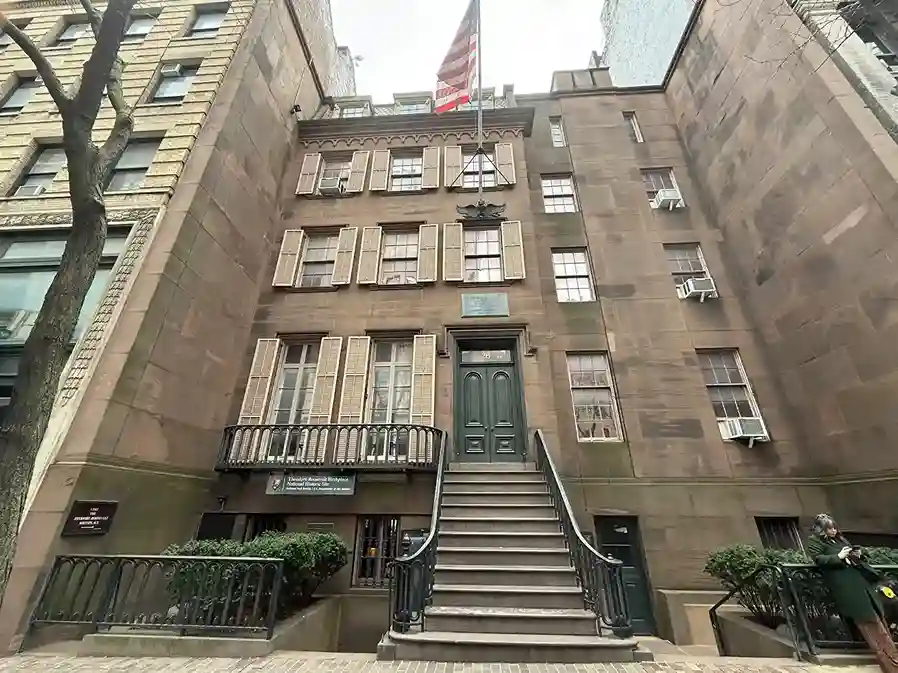

Theodore Roosevelt Jr. (October 27, 1858 – January 6, 1919) was the 26th President of the United States, a Nobel Peace Prize laureate, and one of the most consequential leaders of the Progressive Era. Born in a brownstone at 28 East 20th Street in the Flatiron District, Roosevelt remains the only American president born in New York City. His childhood in this Manhattan neighborhood shaped the reformer who would transform American politics, conservation, and foreign policy.
Roosevelt's birthplace at 28 East 20th Street is now a National Historic Site operated by the National Park Service—one of the few federal historic sites in Manhattan. The reconstructed brownstone, completed in 1923, contains period rooms furnished with Roosevelt family artifacts and tells the story of a sickly child who built himself into a president. Visitors can still walk through the rooms where America's most energetic president first learned to fight.
| Full name | Theodore Roosevelt Jr. |
| Born / Died | October 27, 1858 / January 6, 1919 |
| Profession | 26th President of the United States, statesman, conservationist, naturalist, historian, and author |
| Active in Flatiron | 1858–1919 |
| Known for | 26th President of the United States, Nobel Peace Prize laureate, Progressive Era reformer and trust-buster |
| Key Flatiron location | Theodore Roosevelt Birthplace National Historic Site · 28 East 20th Street · Reconstructed 1923 · National Park Service museum open to visitors |
| Notable legacy | The only U.S. president born in Manhattan, Roosevelt's Flatiron District birthplace is now a National Historic Site that preserves his childhood and the Progressive Era values he carried into the White House. |
Who Was Theodore?
Theodore Roosevelt was born into wealth, privilege, and chronic illness—three facts that defined his early life and the man he became. The Roosevelt family had been prominent New Yorkers for generations, and young Theodore grew up in comfortable circumstances in the brownstone at 28 East 20th Street.
A Sickly Child Who Built Himself
As a boy, Roosevelt suffered from severe asthma so debilitating that his father would bundle him into an open carriage and drive through Manhattan’s streets at night, believing the cold air would help him breathe. The attacks were terrifying—Roosevelt later described feeling as though he was drowning on dry land.
His father’s response changed everything. In 1870, Theodore Roosevelt Sr. built a gymnasium on the second floor of the East 20th Street house and delivered a challenge to his 12-year-old son: “You have the mind but you have not the body… you must make your body.” Young Theodore took this literally, beginning a lifelong commitment to physical transformation that would define his public image.
From Manhattan to the White House
Roosevelt’s path from the Flatiron District to the presidency included stints as a state assemblyman, U.S. Civil Service Commissioner, New York City Police Commissioner, Assistant Secretary of the Navy, Governor of New York, and Vice President—a career that made him the youngest president in American history when he assumed office at 42 following McKinley’s assassination in 1901.
He governed with the same intensity he brought to everything else: breaking up corporate trusts, establishing national parks, mediating international conflicts, and winning the 1906 Nobel Peace Prize for brokering the end of the Russo-Japanese War. The boy who couldn’t breathe became the man who couldn’t sit still. Today, visitors can explore his early years at the Theodore Roosevelt Birthplace, which preserves the home where his transformation began.
Theodore Roosevelt Jr.'s Connection to the Flatiron District
Theodore Roosevelt’s connection to the Flatiron District is both intimate and historically unique: he is the only American president born in Manhattan, and his birthplace at 28 East 20th Street remains one of the neighborhood’s most significant historic sites.
28 East 20th Street: A President’s First Home
The original Roosevelt brownstone at 28 East 20th Street was built in 1848, ten years before Theodore’s birth. The four-story townhouse sat in what was then a fashionable residential neighborhood, home to New York’s merchant elite. Young Theodore lived here from his birth in 1858 until 1872, when the family moved uptown to West 57th Street.
The house where he developed his early love of natural history—he kept a small natural history museum in his bedroom—was demolished in 1916 to make way for a commercial building. Roosevelt, then in declining health, was devastated by the news. Just three years later, he was dead.
The Birthplace Reconstruction
After Roosevelt’s death in January 1919, the Women’s Roosevelt Memorial Association purchased the site at 28 East 20th Street and commissioned architect Theodate Pope Riddle—one of the first licensed female architects in the United States—to reconstruct the house. Using original architectural plans, family photographs, and the memories of Roosevelt’s sisters, Riddle recreated the brownstone in meticulous detail.
The reconstructed birthplace opened to the public on October 27, 1923—what would have been Roosevelt’s 65th birthday. Today it operates as a National Historic Site under the National Park Service, one of the few federal historic sites in Manhattan. The site is a key stop on the Flatiron District walking tour.
Madison Square and Gilded Age Politics
Roosevelt’s connection to the broader Flatiron area extended beyond his birthplace. The Fifth Avenue Hotel at 200 Fifth Avenue (at 23rd Street and Broadway) served as unofficial Republican Party headquarters during the Gilded Age, and Roosevelt attended political gatherings there during his early career in the 1880s and 1890s. The hotel was demolished in 1908; the current building at 200 Fifth Avenue now occupies the site.
During his 1912 “Bull Moose” Progressive Party campaign, Roosevelt campaigned extensively in the Madison Square area, drawing crowds to political rallies near Madison Square Garden at Madison Avenue and 26th Street [VERIFY exact dates of Madison Square Garden appearances]. His third-party candidacy that year finished second—ahead of incumbent Republican President William Howard Taft—a feat no third-party candidate has matched since.
Legacy and Impact
Theodore Roosevelt’s influence extends far beyond what visitors can see at his birthplace—though what they can see is considerable. The National Park Service maintains five period rooms at 28 East 20th Street containing Roosevelt family furnishings and artifacts, including, reportedly, the horsehair sofa where Theodore was born [VERIFY authenticity of birth sofa].
What He Left Behind
Roosevelt’s conservation legacy alone would secure his place in history. He established the United States Forest Service, created five national parks, and protected approximately 230 million acres of public land. The national park system visitors enjoy today exists in large part because a sickly boy on East 20th Street developed a passion for the natural world.
His trust-busting initiatives reshaped American capitalism, his mediation of the Russo-Japanese War won the Nobel Peace Prize, and his “Square Deal” domestic policies set the template for Progressive Era reform. Mount Rushmore includes his likeness alongside Washington, Jefferson, and Lincoln.
What Visitors Experience Today
The Theodore Roosevelt Birthplace National Historic Site at 28 East 20th Street offers guided tours through reconstructed period rooms, exhibits on Roosevelt’s life and legacy, and rotating special programs. Admission is free. The site stands within the historic Ladies’ Mile corridor, and the New York Life Building rises nearby on the site of the old Madison Square Garden where Roosevelt once campaigned.
In an era when presidents came from Ohio, Virginia, or rural America, Theodore Roosevelt was unmistakably a New Yorker—born in a brownstone, raised amid the clatter of horse-drawn carriages on East 20th Street, and shaped by a city that rewarded energy and punished weakness. That his birthplace survived as a National Historic Site feels almost like a civic miracle. Manhattan demolishes its history routinely; Roosevelt's childhood home got a second act.
Key Facts Worth Knowing
- In 1870, when Theodore was 12, his father built a gymnasium on the second floor of 28 East 20th Street and told him: "You have the mind but you have not the body... you must make your body"—a moment Roosevelt credited with transforming his life.
- The original Roosevelt brownstone at 28 East 20th Street was demolished in 1916, just three years before Roosevelt's death, prompting a national outcry that led to the reconstruction effort.
- In 1912, Roosevelt's "Bull Moose" Progressive Party campaign finished second in the presidential race, ahead of incumbent President William Howard Taft—the only time in American history a third-party candidate has outpolled a sitting president seeking reelection.
- Architect Theodate Pope Riddle, one of the first licensed female architects in the United States, designed the 1923 reconstruction of Roosevelt's birthplace using family photographs and the memories of his sisters to recreate the interior.
- As a child suffering from severe asthma, Roosevelt's father would drive him through Manhattan's streets at night in an open carriage, believing the cold air would help him breathe.
FIND THEIR LEGACY TODAY
- 28 East 20th Street — Theodore Roosevelt Birthplace National Historic Site. Reconstructed 1923 on original site. National Park Service museum with period rooms and Roosevelt family artifacts. Free admission, guided tours available.
- 200 Fifth Avenue (at 23rd Street) — Site of the Fifth Avenue Hotel, Republican Party headquarters where Roosevelt attended political gatherings in the 1880s–1900s. Hotel demolished 1908; current building dates to 1909.
- Madison Avenue and 26th Street — Site of Stanford White's Madison Square Garden (1890–1925), where Roosevelt spoke at political rallies. Demolished 1925; New York Life Insurance Building now occupies the site.
- Madison Square Park (Madison Avenue between 23rd and 26th Streets) — Center of civic life during Roosevelt's era; he campaigned and spoke in the Madison Square area throughout his political career.
Explore More of Flatiron's History
→ Step Into History at the Theodore Roosevelt Birthplace NYC (2025 Guide) — Complete visitor guide to Roosevelt's reconstructed birthplace, including tour information and what to expect inside the National Historic Site.
→ Flatiron District History: NYC's Landmark Evolution — Explores the neighborhood's transformation from Roosevelt's childhood through the Gilded Age and into the modern era.
→ Madison Square Park NYC: What to See, Eat & Do (2025) — Guide to the park that served as the civic heart of Roosevelt's neighborhood during the Gilded Age.
→ Flatiron District Walking Tour – Historic NYC Landmarks — Self-guided tour that includes Roosevelt's birthplace and other historic sites from his era in the neighborhood.
→ New York Life Building – A Gilded Icon of NYC History — The landmark that now stands on the site of Madison Square Garden, where Roosevelt campaigned during his political career.
In Plain English
Theodore Roosevelt Jr. (1858–1919) was the 26th President of the United States and the only American president born in Manhattan. He was born at 28 East 20th Street in the Flatiron District, where he lived until age 14. His birthplace is now a National Historic Site operated by the National Park Service—one of the few federal historic sites in New York City—where visitors can tour reconstructed period rooms and see Roosevelt family artifacts.
Frequently Asked Questions About Theodore Roosevelt Jr.
Q: Where was Theodore Roosevelt born?
A: Theodore Roosevelt was born at 28 East 20th Street in Manhattan's Flatiron District on October 27, 1858. The original brownstone was demolished in 1916 but was reconstructed in 1923 as a memorial. Today it operates as the Theodore Roosevelt Birthplace National Historic Site, managed by the National Park Service.
Q: Can you visit Theodore Roosevelt's birthplace in New York City?
A: Yes, the Theodore Roosevelt Birthplace National Historic Site at 28 East 20th Street is open to visitors. The National Park Service offers guided tours through reconstructed period rooms containing Roosevelt family furnishings and artifacts. Admission is free. The site is open Wednesday through Sunday.
Q: Why is Theodore Roosevelt on Mount Rushmore?
A: Theodore Roosevelt appears on Mount Rushmore alongside Washington, Jefferson, and Lincoln because sculptor Gutzon Borglum considered him essential to America's development. Roosevelt's conservation efforts protected 230 million acres of public land, his trust-busting reshaped American capitalism, and his Panama Canal diplomacy expanded American influence globally.
Q: What childhood illness did Theodore Roosevelt have?
A: Theodore Roosevelt suffered from severe asthma as a child. The attacks were so debilitating that his father would drive him through Manhattan's streets at night in an open carriage, believing the cold air would help him breathe. At age 12, his father built a gymnasium at their East 20th Street home and challenged him to "make your body," beginning Roosevelt's lifelong commitment to physical fitness.
Q: Is Theodore Roosevelt related to Franklin Roosevelt?
A: Theodore Roosevelt and Franklin D. Roosevelt were fifth cousins. They shared a common ancestor in Nicholas Roosevelt, a New York merchant who lived in the 17th century. Eleanor Roosevelt, who married Franklin, was Theodore's niece—making the family connections even closer.